Showing posts with label London Squares. Show all posts

Monday, 14 October 2013

Watch the birdie

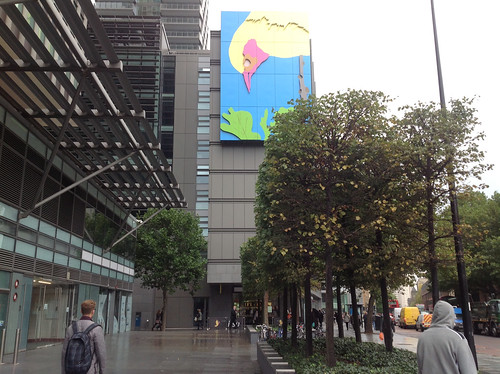
Regent's Place is an island of high-rise development on the edge of Camden, now pushing its boundaries to squeeze in as many square metres as possible. The result is an uncomfortable jumble of very large buildings, all different and competing with each other for attention as well as plot space. Although there are four elements in the last part to be completed, they were designed by two architects, one doing the offices and the other the residential parts. The offices are glossy glass structures which might not be too bad if they had a bit of space around them.

The residential tower, though, is quite possibly the ugliest tower in London, a grim grey structure that looks puny situated as it is alongside the no-frills bulk of Euston Tower (once the home of Capital Radio). A relatively low-rise block of flats along Hampstead Road was designed by the same architect. Come rain or shine, that overall matt grey finish and the complicated balconies do nothing to make the building seem friendly. The final touch, perhaps, is this surprising but not entirely welcome image of a bird fixed high up on the facade. Maybe there will be more of the same, but for now there is just the one. The artwork is by Gary Hume, the YBA who does extremely simple paintings using domestic gloss paint, so simple there is little to appreciate except I suppose a certain degree of abstraction. Here we get a biggish bird, some leaves and a stick, or at least it looks like a stick, although one's first thought is that it's badly drawn leg. Perhaps there are art world characters who think this is an achievement, but it seems perfectly valid to call it an unfortunate bad decision. If not something ruder.

There used to be a giant mural by Michael Craig-Martin on the site, not in the same place but nearby - a pop-art image of an electric fan, several storeys high and lit up at night. It didn't appear to have any particular relevance but it was quite nice as a landmark. The bird doesn't come close to replacing it.


Tuesday, 2 October 2012

The path less travelled

This is one of the small gardens in front of Euston station, popular with office workers as well as the deadbeats who frequent the area - a green oasis in between the bus station and the non-stop traffic mayhem on Euston Road. So why the fence blocking off the path? Well, it's just a dirt path crossing the grass by the most direct route, beaten down hard by many years of use, quite muddy in winter but well used by thousands of feet in a hurry. Not any more. Instead of making a proper path where it's obviously wanted, there's a new fence that blocks the route. One day, perhaps, the council might dig it up and put in some grass seed, but for now it looks rather silly.

Wednesday, 1 August 2012

Flying the flag

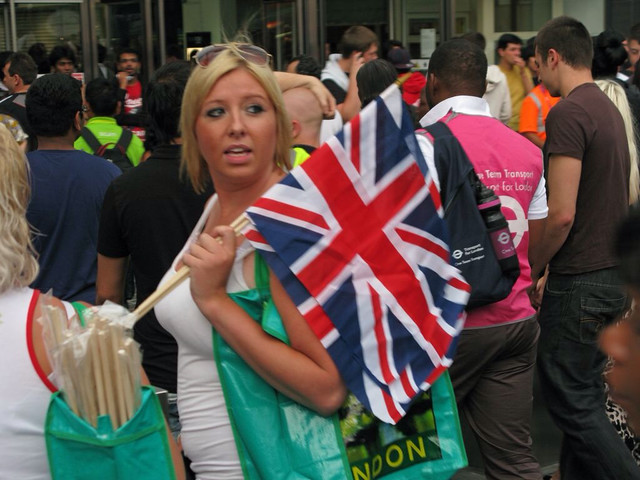
What with the Jubilee and now the Olympics, recently you can't go anywhere without seeing the Union Jack, not just a printed logo but actual flags, flying singly or in strings. There's the traditional version, printed in primary colours on fabric, and similar plastic varieties. Then there's the Olympic version in pink and turquoise, a neat subversion of the nationalistic image. Rows of large Union Jacks are strung across Oxford Street (Regent Street features an international selection). Pubs are festooned with bunting, strings of flags hang all the way round Fitzroy Square, people even carry flags to wave. All interestingly reminiscent of the United States around the 4th of July, Independence Day, when the stars and stripes is on display in every public place, strung across streets and on house fronts, decorating pickup trucks and shop window displays. For now the right-wing xenophobic connotations are completely lost in the sheer enthusiasm for decoration, and maybe it will stay that way, but more likely everything will go back to normal around Christmas, and the NF will get their emblem back. But then again, maybe not.

Wednesday, 4 April 2012

London's pigeon menace

A couple of weeks ago I posted this low-resolution photo of pigeons on a tree, taken on my un-smartphone one lunchtime - with the brief caption, "Be a rebel! Feed the pigeons next time you're eating a sandwich out of doors". I didn't actually feed the pigeons at the time, but it did get me thinking. Since then I've noticed what people are saying about the London pigeons in particular, and more generally the theme of nature intruding on our civilised way of life.

Two things particularly stand out.

First of all, there was an article in the Independent extolling the merits of a maze that's temporarily installed in Trafalgar Square. That square is the focus of Ken Livingstone's anti-pigeon campaign: in 2003 he stopped the bird-seed sellers operating in the square, and shortly afterwards banned feeding the birds and introduced fines to back up the ban. Now there are security guards who are quick to move in if they even suspect anyone of breaking the byelaws. The article in the Independent talks glibly about 'flying vermin' and the supposed health hazards, a standard line of anti-pigeon reasoning that is becoming mainstream self-evident wisdom (although the health issue is largely speculation with nothing much in the way of hard evidence to back it up): pigeons are a nuisance on a par with rats and dirty drunks / drug addicts asking for money. A whole industry has grown up to provide pigeon wires, plastic spikes and netting everywhere a pigeon might want to perch, and the language of their advertisements speaks for itself. Pest control. Deterrent. Reducing numbers. Unhygenic. Using hawks to scare off the pigeons is advertised as an environmentally friendly solution.

The second thing that grabbed my attention was an alleged form of malaise that's being called Nature Deficit Disorder. BBC News reported in March that "British children are losing contact with nature at a "dramatic" rate and their health and education are suffering", according to a National Trust report. The NT are latching on to the term Nature Deficit Disorder, which was invented by an American journalist and probably overstates the case for contact with nature at a formative age, but it certainly corresponds to a sense that wholly artificial surroundings can't be entirely healthy at any age.

Pigeons are related to the domestic doves that were widely bred at one time, now reverted to living wild. They look just the same as wild wood-pigeons and make the same rather beautiful cooing call that you hear in the countryside. Most of them look healthy enough - admittedly not all. Watch the way they move as one but compete for the pickings on offer, observe the pecking order in action, and the way they fly off, circle and land again in a loosely coordinated formation. The pigeons were and always had been a popular tourist attraction, as much a feature of central London as the statue of Eros and the flags on the Mall, until Ken decided to get rid of them. Is that really what we want, isn't there another side to the story? Visitors to London used to come to Trafalgar Square specially to feed the pigeons, not to look at half-baked art on the fourth plinth. The problem of course, is that eating outside doesn't mix well with begging vagrants and scavenging birds, so we discourage both as much as possible - but I'd say we lose something in the  process, another part of the natural world swept out of reach. 

So yes, feed the pigeons next time you see them and have a little food to spare. But don't even think about tempting the security guards at Trafalgar Square.

Wednesday, 14 December 2011

Fitzrovia's fading mural

Half way down Tottenham Court Road is a gap in the shops, an open space called  Whitfield Gardens. It was once a burial ground, and then made into a public park in 1895. In 1945 a German bomb flattened the Georgian houses that separated it from Tottenham Court Road, making the larger space that exists now. All very typical of London: what's left is an accident of circumstances, an odd space  with the single surviving building sitting isolated in the middle of an expanse of concrete paving.
And dominating that space is the 1980 Fitzrovia Mural, faded and peeling, and covered in graffiti as high up as the spray-can artists can reach. People are quite attached to this mural. There was a fashion for murals at that point in history, and this one was commissioned by Camden Council, who own the building it is painted on. The Fitzrovia Neighbourhood Association are campaigning to get it restored, although realistically they admit the wall would have to be repaired first, so the whole thing would actually need to be re-painted from scratch. Some of the subjects are local characters of the time, perhaps not all of them forgotten. There are some nice touches with contemporary relevance: the cigarette advertisement featuring a death's head, the machines spewing out bills and final demands, and of course the developer's crane towering over everything else. Even so, it doesn't have the historic value of the Cable Street Anti-Fascist mural or the Hackney Peace Carnival mural, both in much better condition.

Like the 1960 BT Tower behind it, it's past its best and not that relevant any more. The tower recently lost all the satellite dishes which is what it was for in the first place, removed for 'safety reasons' which will inevitably make space for more advertising, but as an iconic landmark there's a lot of life left in it yet (the photo at the top of this blog shows how it used to be). That painted end wall is just paint, and maybe it's time to treat it as the ephemeral statement it was intended to be. Maybe it's time to make a fresh start with some imaginative, good quality landscaping and some artwork relevant to the twenty-first century.

Friday, 11 November 2011

Mellow yellow

I'm just mad about Saffron.
And Saffron's mad about me.
I'm just mad about Saffron.
She's just mad about me.

They call me Mellow Yellow,
Quite rightly...


Donovan, 1966

The leaves are falling fast, turning yellow and making soggy drifts in this week's drizzly weather. Actually there are some trees that have barely turned, but the London plane trees are going to be bare before long. The parks have different attitudes to fallen leaves: Regent's Park pursues a vigourous clearance programme, while St James's Gardens near Euston has simply disappeared beneath the drifts. In Camden's Oakley Square some half-hearted sweeping was going on yesterday, using a bin liner and a pathetically inadequate broom. The colours of nature are dull in contrast to man-made pigments, though. Here, a yellow bicycle lies among what would otherwise look like bright yellow leaves fallen from a cherry tree - no contest.

Friday, 4 November 2011

The colours of autumn

The colours of autumn are at their best this week, especially enhanced when the sunshine brings out the brilliant oranges and yellows mixed with remnants of green, and London's garden squares are looking spectacular. Drifts of dead leaves obscure the neat pattern of paths and there's something of the wild forest in the ragged look of the half-bare trees. This is Woburn Square in Bloomsbury, a long narrow rectangle of grass bordered by very tall mature plane trees, with terraces of Georgian houses belonging to the University of London on both sides. The simplest arrangement possible, and unlike the garden squares of Kensington and Chelsea, open to the public all year round.

Tuesday, 11 October 2011

Remembering Gandhi

Cycling past Tavistock Square in Bloomsbury, I took a break from my journey to visit the statue of Mahatma Gandhi that sits in the square. A timely visit, as it turned out, because the anniversary of his birth was on 02 October 1869, just a week ago, and the statue sported a garland of orange flowers, cellophane-wrapped bouquets on his lap and more flowers piled on the stone steps. At other times, there are always a few flowers - his fame in the history of non-violent resistance is not forgotten. Gandhi sits cross-legged on a bell-shaped stone pedestal, in the centre of the square, surrounded by sedate English gardening and benches occupied by office workers and academics from London University eating their lunches. The roughly sculpted bronze figure was made by Fredda Brilliant, a colourful globetrotting character, and installed in Tavistock Square in 1968.

Although the principles of  non-violent resistance originate from Buddhist and Hindu philosophy, Gandhi was the first to use those principles in an organised way and on a large scale. He pioneered his ideas under apartheid in South Africa, fighting for the rights of the Indian population there. He went on to become a figurehead of India's long struggle to free itself of British rule, although failing to stop the slide into sectarian violence that followed.

Friday, 30 September 2011

Grey faces in the City of London

A paved sculpture garden, alongside St Mary Axe in the City of London, sits in the shadow of the Lloyds building, the famous inside-out building by Richard Rogers. The garden has trees and planting boxes, and the amazing Sky Mirror by Anish Kapoor, six metres wide and reflecting the buildings around - if you climb something high enough, that is, otherwise as you might expect from the name it reflects mainly just the sky. One side of the garden is enclosed by a long yellow hoarding, concealing the construction site next door, and it seems to be a venue for artworks rather than advertising. Last year it bore a quote from Mahatma Gandhi running the full length of the hoarding: "Be the change you want to see in the world". Recently I spotted these oversize heads photographed in black and white, superimposed on the yellow background.

One lengthy Google search later, I can report that the grey faces are in fact part of a promotion for the insurance company Aviva. Their "You are the Big Picture" campaign put large black and white photographs of supposedly individual customers in noticeable places including night-time projection onto the National Theatre. To quote their website "It shows that we at Aviva want to get to know our customers as individuals". There is a charity link-up with Save the Children but that doesn't mean it's not 100% about self-promotion.

Tuesday, 21 June 2011

Soho facelift

This is the statue of Charles II in Soho Square. It was carved out of fairly soft sandstone in 1681, 330 years ago, which is why it is so badly eroded. Notice his face though: the statue is carved out of a single block of stone, except for his face which is cemented on, like a stone mask. It's a good match, and perhaps replaces a face that was so badly worn or vandalised as to be not much of a face any longer. That face is eroded, but not nearly as much as the original statue.

According to the plaque it was 'Restored to the Square by Lady Gilbert in 1938', Lady Gilbert being the wife of W S Gilbert, of the famous Gilbert and Sullivan musical partnership, and perhaps it was she who decided it was time for the former sovereign to get a facelift.