Showing posts with label Protests and demonstrations. Show all posts

Wednesday, 8 October 2014

The white bicycle

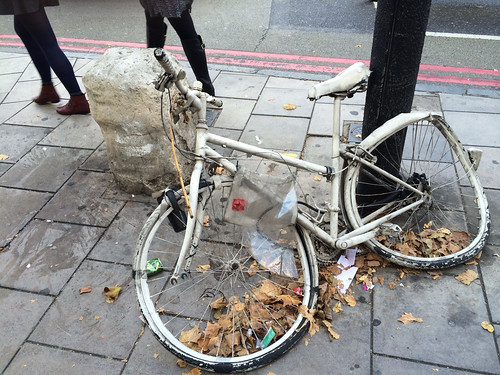
The mangled remains of a bike, chained to a lamp post on a street corner at Kings Cross. A complete bicycle, more or less - it even has mudguards and a bell. The whole thing painted white, not very carefully, flaking off the rubber to show black beneath. Wheels bent and detached as if some half-wit tried to steal them without realising they were locked to the frame. Not a pretty sight, like a dead thing decomposing on the pavement. You might wonder why the council leave it there in the way of pedestrians, collecting dead leaves and litter. Unfortunately there is a reason for that. In 2011 Min Joo Lee, a 24-year-old fashion student, was killed near there in a collision with a lorry. She was the eleventh cyclist killed in London that year. The bicycle is there as a memorial. But maybe it's been there long enough now?

Wednesday, 21 May 2014

In memoriam

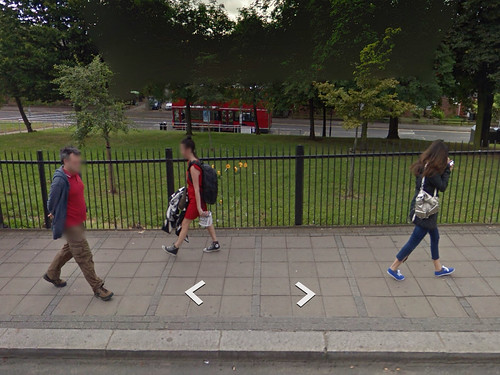
The spot where Mark Duggan was shot in 2011. A few flowers mark the spot, recorded for a while at least on Google Streetview.


Wednesday, 22 January 2014

Skateboard heaven

The end of the holiday season and rain every day, not all the time but consistently dull overcast weather, drizzle and heavy downpours and just the occasional burst of uplifting sunshine. For once I had a three-week break but gardening in the rain wasn't tempting and long cycling trips were out of the question, so drifting down to the South Bank was inevitable sooner or later. Just before new year's eve, I found myself down there for the third time in as many weeks. It's one of the few places in London where you can be indoors without buying a ticket or eating a meal, sit around in comfortable chairs and use the free wifi, look at things and quite likely drop in casually on some kind of unusual entertainment. There are controversial plans for a huge new extension there, and if nothing else it was an opportunity to look at the way the place is now and what might be lost or gained if the changes go ahead.

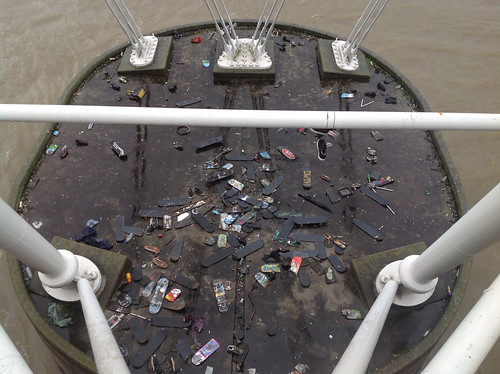
Apart from the depressing scrum outside the London Dungeon and only a modest queue for the Eye there wasn't much going on. Nothing on in the Clore ballroom and only a small exhibition of old protest posters upstairs at the Hayward. Outside was bit like a tawdry funfair after the crowds have left: bright yellow staircases bolted on to the wet concrete, a few set-piece attractions scattered around and sad dim fairy lights overhead. A few people were pedalling the two bicycle-powered snow domes but it was hard to see any effect to reward their exertions. The Gift Factory, a plywood shed painted to look like brickwork, was being dismantled - the tall factory chimney lying on the ground while the walls were taken down. Looking down from Hungerford foot bridge, muddy water churned past one of the oval concrete piers. On the flat top of the pier, dozens of unwanted skateboards were scatted around like an abandoned art installation, a sort of impromptu skateboard graveyard.

The skateboarders at least were carrying on as usual, casually executing undemanding jumps and studiously ignoring the audience, such as it was. It's perhaps the most authentic attraction on this stretch of Thames riverfront, apart from the river itself of course. Change is threatening the status quo, though. A small group displayed a placard reading SAVE THE SOUTH BANK and they were selling tee shirts with the same message. Save The South Bank From Relocation, Support Skateboarding, if you read the small text. The Southbank Centre has plans to develop the space and that will mean booting the skateboarders out.

Once upon a time, museums and art galleries didn't sell anything except a few postcards. Going back more than a few years, the QEH had a canteen-style cafe on the ground floor and a huge empty lobby: no bookshop, no restaurants, certainly no shops selling DVDs and designer junk. The Hayward was the same, a cafe on the ground floor where the bookshop is now, not a franchise but run by the gallery. I don't know what has changed to the extent that these places are now desperate to make money but that is certainly the case. Whatever the reasons, the Southbank Centre is hell-bent on expanding and they want more shops to help pay for that to become a reality. Nobody is saying, of course, how much of a difference a few lettable units is going to make. The place they have targeted for more shops is that skaters' paradise, the undercroft of the Queen Elizabeth Hall.

The undercroft is a sunken space with concrete walls, floor, ceiling, concrete ramps and steps, and distinctive mushroom-headed concrete columns, reflecting the brutalist aesthetic of the building above. It was not apparently designed for any useful purpose: it's just a left-over space that has been used for skateboarding and BMX riding since the 1970s. There is a sense of subversion about the place, with wall-to-wall graffiti (albeit neatly masked at the edges), no supervision, a complete absence of any kind of officially-provided facilities. It is very different from a purpose-made skate park, with none of the flowing curves you see in those places. That quality, the not-designed accidental suitability, is exactly what the skaters value. I haven't asked them, but their views are recorded at length on the Long Live Southbank and Save the South Bank websites. This place is the South Bank as far as they are concerned.

The protest is not particularly articulate, focusing as it does on the history of the place rather than its future value, and no doubt it will be over-ruled - even now that Boris Johnson has expressed support. The development proposals put income-generating retail space in this prime spot, inevitably, but a new skate park is also proposed to compensate for the loss of the present space. The skaters' campaign is in fact just the most visible part of wider arguments against the redevelopment proposal. The National Theatre has submitted a detailed statement of objection. The Twentieth Century Society thinks the sixties architecture should be preserved as it is: they commisioned an artist to make illustrations showing the huge glass extension dumped on top of the Albert hall, and another showing it resting on top of the Tower of London, to illustrate their point about cultural vandalism. Others think a huge insensitive addition on top of the Hayward is exactly in the spirit of the developer-driven culture of greed and appropriation that is rapidly changing large chunks of London.

On the face of it, moving the skate park is a reasonable proposition. As the official website puts it, if the Southbank Centre were commercial developers that would probably not happen: the skaters would just be told they have had a good run for free, but not any longer. They do recognise the cultural value and they are trying hard to make the change palatable. Unhelpfully, they are also reserving the right to use the new space for their own events, and perhaps going the wrong way about designing a new space.

The published design is not an unashamedly modern, state-of-the-art purpose-made park. Quite the opposite, it's designed to look accidental, like a bit of post-industrial wasteland that's been tastefully adapted as a skate park. The proposal is ultra-careful to get it right, using French architects who have done this sort of thing before, and even the architects themselves claim to be skaters. Some actual skateboarding persons have even been brought in as consultants. But somehow they have missed the point. Iain Borden, the professor of architecture at University College London, and the man in charge of organising the proposals, admits it would be preferable to keep the existing undercroft. It's an impossible brief, he says. We want a place that is great to skateboard in, but that doesn't look explicitly designed for skateboarding. The protesters refuse to discuss this option at all, and I think they are right. Bogus authenticity: no wonder support is thin on the ground.

 

Monday, 19 August 2013

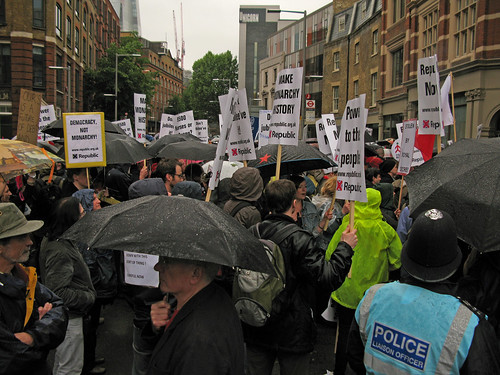
No Justice, No Peace

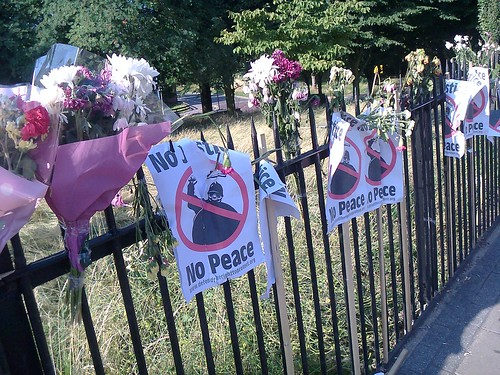
'No Justice, No Peace' read the placards at the spot where Mark Duggan was shot. For the first few weeks after the event there were masses of flowers and cards attached to the railings, and then that was all cleared away and nothing was left but bare railings. Recently, around the second anniversary, and with the subject still in the news, this little display sprang up. That phase comes from the LA riots in 1992, and it's found various uses since. Already, the flowers and placards are gone, leaving just the sticks sellotaped to the railings. Maybe it's best that the spot remains unmarked, although the shooting and subsequent riots will stick in the collective memory for a long time.

Monday, 3 September 2012

E17 in the news

Warehouse fire 25 August
The English Defence League descended upon Walthamstow on Saturday. Despite small numbers, between 200 and 300, the area was completely disrupted from midday onwards. Counter-protesters were kettled at the Bell junction, roads were blocked by an unprecedented army of police and police vans trying to keep the two sides apart, and part of the EDL contingent were still stuck outside Blackhorse Road tube station late into the evening.
 
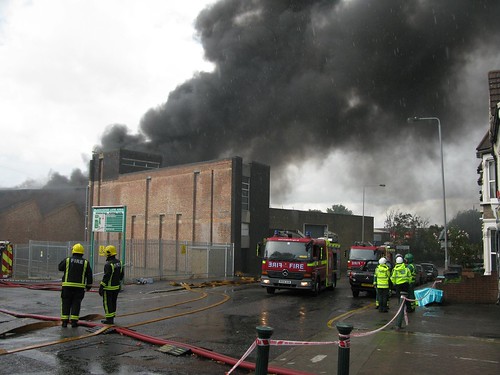
The event didn't feature at all in the media, apart from the usual alternative internet news and the local paper, the Guardian series, and the Metro website. A warehouse fire (pictured above) the previous weekend made it on to BBC news: nobody hurt and no homes evacuated, although it did take the firemen all day to put it out. But perhaps ignoring the EDF is deliberate. It certainly felt like news if you were in the area at the time.
 

Tuesday, 5 June 2012

Making Monarchy History

It would be an understatement to say Saturday's Jubilee river pageant was well attended. You might think people have better things to do than stand out in the rain for hours waiting to see some boats go past, but you'd be mistaken. I really ought to know better, but in the event I went along to London Bridge about three o'clock, expecting to catch some of the boats as they passed the finish line, only to find huge crowds milling around up and down outside the station, looking in vain for a way to get to the Thames. We got within range of a big screen on Tower Bridge, but that's no different from watching television at home, if you discount comfort factors like a roof to keep the rain out, a sofa and a loo within easy walking distance. I spoke to a policeman who told me he went on duty at seven in the morning and people were lining the railings even then. A huge number of visitors who didn't have quite that level of determination must have come away without seeing anything at all.

The annoying thing about this is not that there wasn't room for everyone who turned up to get close to the river, but that access was so tightly controlled that the riverside spaces were in fact half empty. Near the London Assembly you could get up to the barriers easily enough, close enough to see spectators a few deep along the riverside railings, and acres of empty wet concrete behind them, but the security staff were not letting anyone through unless they had a ticket (apparently available in advance). This new craze for security may be getting just a little out of hand. Aircraft carriers on the Thames and police with machine guns (no kidding) at London railway stations are just the tip of the iceberg. On this occasion, all the bridges were closed except to invited and security-cleared participants, and there was a control barrier at every single point that gave access to the Thames.

So we had crowds and a cheerful holiday atmosphere, but really nothing happening - except for this small but quite noisy demonstration waving their placards and adding to the congestion on Tooley Street. Better than nothing, and where but an anti-monarchy demonstration would you see the message, 'Down with this sort of thing - careful now'?

Apart from that little gem, we were not amused.

Sunday, 29 April 2012

Cycling in the rain: the Big Ride

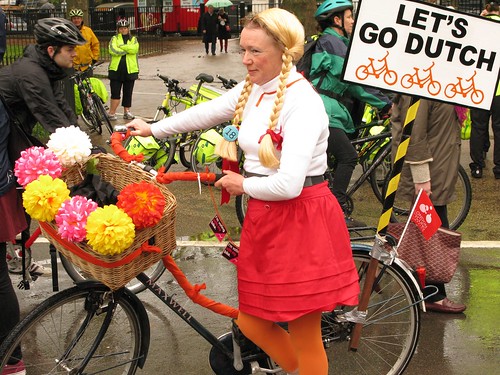
According to the London Cycling Campaign ten thousand people turned up for the Big Ride on Saturday, despite a steady drizzle and grey skies all day. It certainly seemed like a lot of bikes and people from the stage area, at the bottom of Park Lane, waiting for the ride to start moving: a sea of red and yellow waterproofs packed in solid, all three lanes, all the way back up to Marble Arch. The roads were closed to traffic, but this was nothing like the Skyride, no tearing around in both directions. The ride proceeded sedately, stopping at pedestrian crossings, so it took just over an hour to get from the starting point to the finish line on the Embankment.

The point of the ride was to support the LCC's campaign to make London's streets more people friendly. There's been a certain amount criticism of Boris Johnson in connection with the issues of cycling safety and giving priority to vehicular transportation, to the point that it almost seemed inappropriate to come to the ride on a Boris bike. It's worth considering his actual achievements though. A cycle hire scheme that seemed to materialise overnight. The cycling superhighways, incomplete and widely criticised but still quite a step forward. Decluttered streets (probably miles of railings removed and a move towards shared space, intended to promote shared responsibility (Exhibition Road, Oxford Circus)rather than enforced separation. Not everything he's done is right or admirable but as Londonist says today, apart from his vanity projects, quite a lot of what he's done is relatively modest, making quiet incremental improvements that spend money where it can really make a difference.

Friday, 10 February 2012

Occupy LSX - Time to move on?

The Occupy camp at St Paul's is thinning out. After more than 100 days of occupation, there are still as many tents as can physically fit on the site, but the buzz has quietened down. The imaginative posters that used to adorn the stone arcade opposite the cathedral have all been taken down, leaving a few tape marks but nothing worse. Occupy LSX was extraordinarily successful in raising the stakes in the people v the banking system debate, and equally lucky in finding themselves in perhaps the one spot where they would not be summarily turfed out. Now though, the camp is not really in the news any more, and you have to ask - is it time to move on? Wouldn't it be more impressive to announce a moving out date, do a massive clean-up and hand Paternoster Square back to the cathedral, create some positive publicity instead of hanging on until a legal eviction gets under way, almost inevitably with a degree of violence. The protesters will argue that they need to be together in order to have a collective voice, but is that really necessary, when it's possible to meet up for events, and keep in touch via the internet in between times? Well that's what I'd suggest if I was part of the protest camp, but then I'm not.

Thursday, 3 November 2011

More to Life than Money

Against expectations, the Occupy camp at St Paul's cathedral looks likely to stay until the new year, with St Paul's and the City of London Corporation both deciding against legal action to evict the protesters. Crowds gather on the cathedral steps every day to hear what's being said at the twice-daily assemblies. A powerful PA system mounted on a tricycle means the speakers can now be heard clearly, and disruptive heckling is relatively quiet. Some friction yesterday as a man took the microphone to pursue his own agenda, evidently deemed not relevant by the organisers, and shouts of "get off" failed to discourage him, but he soon lost the microphone. Elsewhere, a man was putting on a suit of armour and a Guy Fawkes mask, and a giant Monopoly board (reported to be donated by Banksy) sits next to the row of portaloos. Meanwhile the tourists continue to make their way through the crowds to tour the cathedral, which remains imperviously serene inside.

Tuesday, 1 November 2011

Critical Mass meets the St Paul's Occupy protest

One less car - Norwich
Last Friday, the last Friday in the month, saw the regular Critical Mass ride visit the tent city at St Paul's not just once but twice, heading straight there and then returning via a long loop. Like Occupy, the Critical Mass protests are more about highlighting issues than about proposing concrete solutions, and have a similar leaderless democratic structure - no membership and no agenda, you just turn up and take part. Which is not to say those taking part are not serious about protesting against the way cars and lorries endanger everyone else using the roads.

Londoners probably don't realise they are not the only place where Critical Mass rides take place. There are at least 24 other UK cities that have Critical Mass events. As it happens I was in Norwich that Friday, sitting on the steps at the Forum in the city centre when cyclists began to assemble there wearing various kinds of fancy dress. I didn't realise what they were doing until our park-and-ride bus out to the airport slowed to a walking pace as this same group took the ring-road out of town, occupying the whole width of the road. A modest group of just sixteen riders is hardly a critical mass, but it's a start.

Saturday, 22 October 2011

St Paul's - Forgive us our trespasses

The doors of St Paul's are closed today, just like it says in the news. That makes the steps and forecourt into a fantastic natural amphitheatre, with the massive corinthian columns lending their imposing presence to the event. The protesters are making good use of the location, although most likely everyone would have been happier if that was not at the expense of closing down the cathedral. This afternoon a succession of speakers made their points from a microphone set up by the Queen Victoria monument, to an audience sitting on the cobblestones, and more people standing around them and all over the steps. A sizeable turnout, with more people arriving by bus, Tube and on Boris bikes, but not overcrowded. The weather is fine and everyone seems cheerful, even the police.

The Portland stone colonnade of the Paternoster Square buildings opposite has been taken over as a poster wall, with the piers and columns covered in imaginative printed and handmade posters - more arty satire than political rant. There's no pasting, everything is carefully taped to the stone, some with printed tapes reading 'Capitalism means War' and 'Another World is Possible'. One of my favourites was just plain stencilled lettering reading 'More to life than money', with the 'O's drawn as bombs.

Organisation is better than it was earlier in the week. A busy kitchen is handing out free meals, and they have lots of boxes of apples. Bins are labelled with instructions for recycling and sorting, and there was a council rubbish collection in progress. Portable toilets, although only two of them, are locked until the public ones close for the night. A fenced-off fire escape route for the cathedral is presumably now redundant but still kept clear. Some bigger tents have appeared but there is still plenty of room to walk through the site. No litter and no vandalism to be seen. This does affect local businesses though - the staff in Paul, the French sandwich chain, say that their takings are down because they usually have tables outside and there isn't enough room now. Policing remains low key: Paternoster Square is fenced off and both police and security guards are making sure no-one gets in, but there are no police lines, just pairs of officers walking around in hi-viz uniform.

Friday, 21 October 2011

St Paul's protest - poster making

Paint, crayons and markers: making posters next to St Paul's portico.
Large streams from little fountains flow, Tall oaks from little acorns grow.

The St Paul's protest camp, far from fizzling out from lack of commitment, seems to be growing in size. Contradictory media reports suggest support from Canon Giles Frasier of St Paul's cathedral, but also reporting that the cathedral might have to close. With protesters talking of a long stay, and not the slightest chance of changing the entire international financial capitalist situation overnight, it's not difficult to foresee a replay of Dale Farm at some point in the future. It's impossible to predict what effects this worldwide movement may have. Meanwhile this looks like great fun to participate in.

Monday, 17 October 2011

Tent city at St Paul's Cathedral

So much goes on in London that it's easy to be blissfully unaware of even dramatic events like this. I vaguely registered that protesters are occupying part of Wall Street and Times Square, but it was only when I bought the Independent's baby sister paper i this morning that I found out we have our own protest occupation, not in the City - security is presumably draconian there - but at that symbol of London, St Paul's Cathedral. And even so, coming up from the Tube the scale of this is surprising. There are over a hundred tents pitched in Paternoster Square, and makeshift enclosures of tarpaulin strung up by the cathedral railings. Lots of placards, organised catering and a bank of portaloos, a media centre, speakers going on about practical matters and a lone guitarist with his battery-powered amp, completely ignored. An excitable but entirely peaceful atmosphere. The tourists continue to pile into the cathedral - the protest wisely keeps the main entrance steps clear - and there is an extremely modest police presence. Some of the beautifully lettered slogans:

REVOLUTION
CAPITALISM IS CRISIS
WE ARE THE 99%
END CORPORATE GREED
PLANET 4 SALE POPULATION 6BL RESISTANCE EXPECTED
and my favourite, 
$ELL YOUR STOCKS, IT'S OV£R...

Tuesday, 11 October 2011

Remembering Gandhi

Cycling past Tavistock Square in Bloomsbury, I took a break from my journey to visit the statue of Mahatma Gandhi that sits in the square. A timely visit, as it turned out, because the anniversary of his birth was on 02 October 1869, just a week ago, and the statue sported a garland of orange flowers, cellophane-wrapped bouquets on his lap and more flowers piled on the stone steps. At other times, there are always a few flowers - his fame in the history of non-violent resistance is not forgotten. Gandhi sits cross-legged on a bell-shaped stone pedestal, in the centre of the square, surrounded by sedate English gardening and benches occupied by office workers and academics from London University eating their lunches. The roughly sculpted bronze figure was made by Fredda Brilliant, a colourful globetrotting character, and installed in Tavistock Square in 1968.

Although the principles of  non-violent resistance originate from Buddhist and Hindu philosophy, Gandhi was the first to use those principles in an organised way and on a large scale. He pioneered his ideas under apartheid in South Africa, fighting for the rights of the Indian population there. He went on to become a figurehead of India's long struggle to free itself of British rule, although failing to stop the slide into sectarian violence that followed.

Wednesday, 10 August 2011

Tottenham reflects

Residents at a street meeting on Monday evening at Tottenham High Cross. Like speakers corner but with much more urgent things to talk about.

Saturday, 30 July 2011

London cycling, last Friday of the month

The last Friday of the month is the regular slot for Critical Mass, when hundreds, possibly thousands of cyclists converge on the South Bank, setting out around 7.00pm on an unplanned and highly disruptive route around central London. Disruptive to traffic, that is. The message is not overtly political, it's just a reminder that not only cars and lorries use the streets. It's interesting to see how safe the whole thing is: there are seldom collisions, and as a pedestrian you can just walk out to cross the road and the bikes weave around you, although a few people clearly think they have to wait for the whole thing to pass.

This month there is a flashride at 6.00pm to protest about the traffic proposals for Blackfriars Bridge, starting at the south end and heading back down the other side, which causes an effective traffic jam for half an hour each way. Most of the riders then head en masse down to the National Film Theatre to join the main ride. You can tell it's summer because numbers are down from usual, but it's still a decent road-filling slow-moving crowd. On the narrow streets behind the National Theatre the procession goes at a snail's pace, perhaps not the most visible use of numbers when we could have used the main road. Blackfriars Bridge is blocked again on the northbound side, but not for long. Self-sacrificing (or foolhardy) types stop their bikes in front of cars to stop them pushing into the route and needless to say this can annoy the drivers, who sometimes get out to argue, but it's reasonably clear that there is no point trying to pass when the entire road is completely full of bikes. The taxi drivers hate this and lean on their horns, van drivers inch forward aggressively, motorbikes try to weave their way through the mass of bicycles, but it's actually a short wait and most people wait calmly, some are even amused. The police are relaxed, waving stragglers through red lights to keep the group together.

Saturday, 23 July 2011

Blackfriars Bridge and cycling safety - a test case

The London Cycling Campaign has been pushing hard for a review of proposals on Blackfriars Bridge. For those who get the bridges mixed up, which is probably most us, that's the one that runs next to the twin turrets of Blackfriars Station, via a major traffic snarl-up where the Embankment runs into Queen Victoria Street, and running parallel to Blackfriars railway bridge and the abandoned piers of Thomas Cubitt's original railway bridge. 

London's bridges are traffic bottlenecks and can be dangerous with impatient rush-hour traffic and high speeds at non-peak times. London Cycling Campaign has been pushing for the temporary 20 MPH speed limit to be kept in place on Blackfriars Bridge, but Transport for London want to change back to 30 MPH to keep the traffic moving. Last time the matter was raised at the London Assembly there was a walkout by all the Conservative members, for completely unrelated reasons. That did give LCC a chance to collect 2000 photographs and email addresses to make a graphic form of petition - a composite image of a 20MPH sign, a message somewhat  compromised by repeating some of the photos for graphic design reasons, but still a strong indication of support from cyclists.

This week the Assembly did debate the motion, and all parties came out in favour of the lower speed limit and a review of proposals. TfL have previously proposed a lower speed limit on all London bridges, and there are proposals from the Mayor to make the whole City of London a 20MPH zone, but there are conflicting interests: despite the strength of feeling that London should be moving towards a safe and pleasant environment for people and cyclists, the traffic lobby has considerable clout. And of course a significant part of the public thinks cyclists are a menace.  A temporary  win then, not a permanent one. 

More details and links are on the London Cycling Campaign website.