

Showing posts with label Exhibitions. Show all posts
Showing posts with label Exhibitions. Show all posts
Tuesday, 21 January 2014
Mind over matter


Tuesday, 5 March 2013
Electronic and kinetic art at Ambika P3

Kinetica Art Fair was open over the weekend at Ambika P3, the gigantic underground structures laboratory in the basement of the University of Central London, which was once the Polytechnic of Central London and a hotbed of architectural and structural innovation. The show featured an eclectic assortment of creations ranging from hi-tech to Heath Robinson, but it somehow lacked a defining sense of achievement. There were plenty of fairly amusing things but hardly anything to take your breath away and leave you wondering why that had never been done before.
The entrance to P3 isthrough some kind of maintenance yard, through a narrow doorway where people with tickets were left wondering if they had to join the long queue, or push their way through. Inside, you enter via a balcony overlooking the main space. The smell of frying burgers was not encouraging and the place was too crowded but the space itself is dramatic.
There were some very charming handmade exhibits, slapdash in the best kind of way, made to just about do what they are supposed to do without excess polish. A small tree branch suspended from three concentric rings, with the twigs cut exactly at the line of the rings above them, so the whole thing scrambles, and then reassembles again as a complete branch. Silly stuff like vibrating pictures that you couldn't see properly because of the movement. An old typewriter that no longer typed words, but had a nylon filament connecting each key to one of around forty noise-making devices: arms that struck bottles part-filled with water, a worm drive that sent balls down a chute, each mechanism different and amusingly impractical. The good thing about those was the way you didn't need an explanation, you could just watch and the whole thing was apparent. I didn't mind the tiny sailing boat with a rotating spring mimicking the rise and fall of waves, although that was just a little feeble. There was a beautifully made ball race, sending ping pong balls on twisting wire ramps, taking one of several routes down to the lift mechanism.
A lot of the show was predictable, and the hi-tech tendency which you would think must be the driving force behind this show, turned out to be less sophisticated than you might hope. Mutant robot monsters in the familiar heavy metal mould, a real live model wearing some kind of bondage outfit with robot appendages, stuff made out of bicycle gears. Lots of diffraction effects achieved in different ways. A whole room of effects with lights and mirrors. There was one thing I'd read about beforehand, a shiny cylinder reflecting a strangely-shaped metal blob, the blob being precisely calculated to look like a human hand in the distorted reflection. It worked, and you could see why it worked but that was all it did. Finally, I found something promising, a wooden lay figure about a foot high and next to it a modest array of electronics. The instructions were: stand on the black square with your hands up as the diagram shows. When the machine has finished scanning your body, a red light will show. Then you will be able to control the movements of the lay figure by moving your own body. It was out of order though.
Really, the star of the show was the two-metre metal globe suspended over the balcony from one of the industrial gantries that run across the ceiling. Covered in a grid of lights programmed with an ever-changing display and placed where you can stand right next to it, or see it from the far end of P3: nothing not to like about it.
Sunday, 24 February 2013
David Bailey at the William Morris Gallery

The newly refurbished William Morris Gallery opened in August last year with a bit of a coup, a rare viewing of the 14 metre long Walthamstow Tapestry by Grayson Perry. The place was down at heel, hardly ever open when you'd want to visit and always the same when you did get inside, so a revamp is quite welcome - even if it is perhaps a little too child-friendly. The purpose of the revamp is evidently to shift the gallery up a gear, from local Walthamstow attraction to a place in the London art world. This new exhibition is a selection of images of the East End by sixties icon David Bailey, reinforcing that objective. There are two quite different sets of images in the show, black and white street scenes from 1961, and much larger colour photographs of people in pubs and clubs from 1968. Bailey's photographs portray a world rather different from that same geographical area today.
Gritty, grainy scenes of children playing on bomb sites and tumbledown brick terraces are one part of it, the earlier set. Printed at modest size in high contrast deep black with a black border, they show half-familiar streets with that different life going on. They have a period charm, a kind of photography that was fashionable then and dates them quite separately from the subject matter. He uses that trick of waiting for someone to walk past so as to get a figure in the foreground, or captures his subjects apparently unaware - they might be apologising for getting in front of the camera, but he presses the shutter button precisely where they will be framed against a shop front or a pub window. The children, on the other hand, are obviously keen to strike a pose for the sake of a little attention. The background is relentlessly broken, damaged, worn out. It's almost jarring, then, to see Jean Shrimpton looking like the star she was, posing in an oversized sweater in the dingy hallway of his parents' terraced house. The down-at-heel East End has become such a cliche of the era that it very nearly misses that quality of affording an inside view, a sense of looking back in time and seeing how things really were, but you do get a strong sense of just how much things have changed. Apart from Jean, though, the subject matter is interesting but if you found them in a box of old photographs in a junk shop, you wouldn't think they were anything special.
Those black and white images are set against the seedy nightlife of pubs and private drinking establishments, photographed in washed-out colour and printed much bigger. These are sleazy scenes shot in unglamorous surroundings: peeling paint, cheap furniture and some truly awful wallpaper. Two peroxide blondes with dark eyebrows pose with drinks in hand. A rough-looking geezer with a broken nose, creased clothes and a filthy rag around his neck holds up his dimple glass in one hand, the makings of a roll-up in the other. A couple of characters sit alone in their overcoats, and some men in decent suits are clearly slumming it out east. Last but not least are the Kray twins, blown up life-size and leering evilly, almost comically, holding their twin pet snakes. You wonder what they must have made of David hovering with his camera, but of course he was a local boy and must have known how to fit in, how to talk his way into a crowd, flattering people to get them to pose for the camera. What you don't wonder is what to make of the images: they speak for themselves, showing a huge leap of confidence since those earlier street scenes.
It's not a huge selection of images and you're left wanting to see more - that would have made this a stronger show.
Monday, 11 February 2013
What's going on at Tate Modern?

Frankly, Tate Modern is a bit of a mess. Arriving on a cold, wet Sunday afternoon, you battle the icy winds across the Millennium bridge, with a view of a long line of people pressed up against the glass, high up in the old power station. You get to the end of the bridge only to be turned back, to a down ramp facing away from the main attraction - unless of course you see the river and the view of St Paul's as the thing you would most want to look at. Inside the Tate, the escalators glide past behind plate glass, completely inaccessible, and you walk through to a railing overlooking the lowest level. Down there, children are playing around four or five scruffy yellow nylon tents, surely too half-baked to be an art installation, but you never know with art galleries. A black tarpaulin and some scaffolding seem to indicate work in progress: maybe there's a sign somewhere explaining it.
So down we go to the lowest level to get to the bottom of the escalator, in order to go up. Don't architects think about that sort of thing, or is it actually deliberate, a way to make sure nobody goes straight up without first... well what plausible reason is there for making sure to visit that level first? Don't the people who run the Tate realise that Londoners are going to come for fifteen minutes to see an old favourite, or for an hour to meet someone and see what's new on the fourth floor. They're not going to go down, buy tickets for all the current expensive pay-to-visit shows and make a day of it, making sure they see everything there is to see. No, what you want is to go straight up.
But to return to the theme of mess: up at the top, groups of sullen teenagers are sitting on the floor slumped up against the glass balcony, the toilets stink, and the cafe is a no-go area of kids' games and no free seats. There's all those big empty spaces with absolutely not a single work of art in sight. Surely the galleries will buck that trend, at least. I'm not so sure though. As far as I could make out from an admittedly casual walk round, the entire gallery is hung on a thematic basis with titles like Structure and Clarity, Setting the Scene, and something about Energy, none of which helps much unless you want to read an essay first, and even then the selection includes a lot that is second rate and some connections that are amazingly superficial. That approach must be great fun for the curators, a vast pick and mix selection process and a chance to show off some theories. If you just want to look at lots of pictures and make your own connections, though, the whole thing is really rather infuriating.
It's refreshing, then, to come across an entire room devoted to Cy Twombly, an artist who's never particularly interested me, and to be slowly convinced of the value of his work by the simple process of seeing a decent sized collection of paintings and sculptures all together, without anything else to distract attention.
Otherwise a frustrating experience - go to the old Tate if looking at art is what you want to do.
Friday, 7 September 2012
The art of street photography

Sunday was a bit quieter and I did visit the rather baffling conceptual art at the Quaker meeting rooms. Close by is the Rose and Crown pub, where I wanted to see Matt Russell's Motion Blur, simple but effective mobile phone photos of people captured from the top deck of a bus - he calls this 'something of an obsession'. Then at La Delice cafe, a show by Esther Simpson titled People I don't know which delivers as promised, fascinating glimpses of other people's lives. Quite eccentric lives, some of them.
It would be interesting to know if the subjects of Esther's photographs were unaware of being photographed, as it appears, or if she just asked them not to look at the camera. Maybe a combination of both, since people react in different ways to a camera: some will want to pose, others hate being photographed or want to make themselves presentable first. A few might be doing something dodgy and definitely don't want anyone taking photographs. As I found out when I tried to photograph a car wash in Tottenham - the camera sometimes just arouses suspicion. Outside the Olympics on opening ceremony day, a girl passing by actually hit my camera because she had to walk in front of it. Capturing strangers on film is of course the absolute basis of street photography and while you could well argue that there's far too much of that sort of thing, if you are out taking photographs you'd hope not to annoy too many people in the process.
The photo above is from Walthamstow in perspective, number 11 on the Art Trail, opening on Saturday.
Thursday, 21 June 2012
London Festival of Photography, a critical tour

There are 24-hour displays at both Kings Cross and St Pancras, Contemporary Street Photography at Kings Cross and The Great British Public, from the book of the same name, at St Pancras. Half the fascination, though, is not so much the actual photographs, as getting carte blanche to walk through normally closed doors. In a borrowed or temporary gallery on the top floor of a seedy Oxford Street building is the International Street Photography awards show, where windows uncleared for decades look out over the taxis and buses. The photos are original and striking, although I was sorry to see the winning view of Mexican workers sleeping in the back of a moving pickup truck, had been repeated with endless variants.
Repetition is all too common in photography - making series of images instead of thinking up new approaches - but unique images are much more interesting. One of the shows at the Fitzrovia Community Centre, Behind Closed Doors, is another case in point. The stories of abuse suffered by female domestic staff in France are well worth reading, but all those images of anonymous apartment buildings, the scenes of those crimes, really add very little to the project. So much easier than photographing the abused women, or stalking the perpetrators to publicly shame them, but the buildings tell you nothing except that there must be thousands more cases of exactly the same kind of bad treatment. The Single Saudi Women show by Wasma Mansour similarly disappoints: the women barely appear and their surroundings are merely ordinary.
The Horse Hospital, normally un-noticeable around the back of Russell Square tube station, is suitably weird, a ramp instead of stairs and a miniature stage draped in red velvet. The family history recorded there by Kurt Tong is reasonably engaging, but only if you can be bothered to read all the background information.
Two shows near Euston are much better versions of the personal narrative. At the William Road Gallery, which is actually the reception area for architects John McAslan and Partners, are several intense and fascinating collections, especially Celine Marchbank's record of her mother's terminal illness, put together with considerable wit and barely a hint of pathos. Also striking are Evgenia Arbugaeva's images from Siberia, showing at Calumet: revisiting the small and desolate town in Siberia where she grew up, she finds a young girl to pose, in a sense, as her younger self. The poverty of the post-USSR town is striking, bleak concrete apartment buildings and battered interiors, contrasting against the moonscape beauty of the landscape. The girl poses in her bedroom, on the prow of an icebound ship and balancing on rusty machinery, throws her shadow against an abandoned building, runs with a meteorological balloon nearly as big as she is, stands balanced on a tiny raft on the icy waters of a lake. Again, imaginative and unsentimental. I've taken the liberty of copying one of her images above. There is more to enjoy on her website http://www.evgeniaarbugaeva.com/, or get down to Calumet while it's still on.
Thursday, 24 November 2011
Russian constructivism at the Royal Academy

The courtyard of the Royal Academy is currently the setting for this steel tower, a striking twin spiral supported on zigzag bracing, but somewhat overwhelmed by the architecture surrounding it. It is in fact just a scale model of the tower designed in 1920 by Russian architect and engineer Vladimir Tatlin, just three years after the October Revolution and before the USSR was established. Designed as a monument to the Third International, only a model was built at the time, and now just Tatlin's drawings survive. If it had been built, it would be 400 metres high, higher than the Eiffel Tower in Paris.
It's widely held to be a masterpiece of Constructivism, the avant garde movement linked with the early years of the communist state - before reaction and repression set in. Conceived at a time that coincides with the Edwardian period in England, it's quite difficult to understand such an abrupt change, from the amazingly modern and forward-looking futuristic designs adopted by the budding socialist state, to the suppression of artistic expression that followed on all too soon.
Tatlin's masterpiece would have towered high above St Petersburg, but it was never built because of political uncertainty, perhaps because it was physically impossible, and because it would have been extraordinarily expensive. None the less it remains legendary both as an early expression of modernism, and as some kind of socialist icon.
The scale model at the RA was designed by architect Jeremy Dixon, who made a slightly smaller wooden version for an exhibition at the Hayward in 1971. This time around he has the benefit of computer aided modelling, not available in the 1970s, but because it's based upon drawings and photographs of the original model, none of which are the same, it's an interpretation rather than an exact scale copy. That circular base has nothing to do with Tatlin's design and rather spoils the effect of the dynamic form rising out of the ground, dissipating the vertical thrusting energy by introducing that broad wedding-cake base. No doubt that keeps it nice and stable, but it would have been better without it, better still if the whole thing was twice as big and really dominated the RA courtyard.
Thursday, 15 September 2011
Artists at Blackhorse Lane
 One of the highlights of the recent E17 Art Trail was the open studios at the Barbican Arts Group Trust. I managed to spend an hour out of a busy day there last weekend, and wished I had more time to look at everything properly. There are 28 artists studios and after spending time looking at the first few studios at a leisurely pace, of course I ran out of time and had to skim what may have been equally fascinating things towards the end.
On a buzz from talking art all day, I plucked up courage to ask some of the artists if I could photograph them. Mike Thorn (top) has an enviable light-filled corner studio, in contrast to some of the windowless internal spaces. His portraits of macho men reveal them to be big softies - at least part of the time. Strong stuff, large canvases portraying his subjects larger than life-size. He was happy to pose with his easel and paint table against the current work in progress.

Next door, I was impressed by Helen Maurer's plywood paintings, shaped panels with abstract designs superimposed. She has one of the windowless spaces, improved by taking out the false ceiling to let in daylight from the rooflights in the unused loft space above. I copped out of asking to take photographs though.

Near the entrance, Michelle Reader (above) showed papier mâché figures, apparently self-portraits, which I wrote about in my last post. I asked her to pose with her rather photogenic junk pile.

Tam Joseph (below) shares the same view but his studio has a different feel, with small framed paintings competing for attention with the centrepiece, a version of Cranach's Adam and Eve. Foliage on one wall half conceals an array of postcard-size paintings based on those prostitute cards you see in telephone boxes. The same temptresses appear in the tree behind Adam and Eve instead of boring old apples.

Finally Julie Caves' colourful abstracts (below) were on show in a windowless internal space but seemed none the less vibrant in the fluorescent light. I just asked to photograph the studio, cleared for the show and paintings stacked and hung against white sheets that conceal the stacked-up studio junk.

Tuesday, 30 August 2011
Ron Arad's Curtain Call at the Roundhouse

So much for the technology. This works as an immersive experience: walk in through the moving image, sit inside surrounded by movement, walk around the outside trailing a hand against the rods, watch the interaction of people and installation. There is a rolling programme of twelve specially created works. The best use the whole space, like Matt Collishaw's Sordid Earth, a tropical thunderstorm mixed in with time-lapse footage of withering orchids. Others simply repeat a projection round the circle, with different degrees of success. Javier Mariscal does that but creates plenty of excitement with his animations and, like Andy Warhol, makes a virtue of repetition.
The Roundhouse advises 'pay what you can' which effectively means pay the recommended five quid, or risk embarrassment on a level with asking for tap water in a restaurant. Some cushions would have been nice - I bet Ron doesn't care to sit on a hard lino floor for two hours.
Monday, 27 June 2011
Architecture at the Royal Academy Summer Exhibition

The star of the show is the Shi Ling Bridge by small practice Tonkin Liu - an organic, flowing perforated structure spanning a rocky gorge. It is rightly given central position in the room: at a glance you can understand the scale and the structural logic, and appreciate how it would enhance a natural landscape. Similar clarity is in evidence in the Hairy House by London architects Shiro Studio. Following a long line of one-off Tokyo architect-designed townhouses, this one is a simple rectangular slab covered in white astroturf, with a car-size indentation for parking and gloopy amoeba shaped windows apparently made of white perspex. At the other end of the scale, an elaborate model of part of Battersea Power Station imagines the interior as a sort of biological mutation. It's intricately built using 3D printing technology, and rather pointless.
Studio East by Carmody Groarke is a pop-up restaurant that was on the Olympics site last summer, built out of stretched fabric on a scaffolding frame. It's shown as a moderately impressive aerial photograph, one of the few images of a completed project. It's also probably the only project on show that has since been taken down. There are a couple of other photographs of oval structures in sombre black and white. FAT are showing a cartoonish but slightly dull birds-eye view of a suburban district in County Durham populated with their trademark quirky buildings.
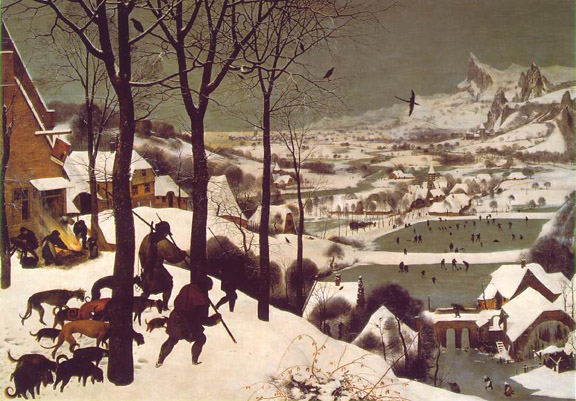
Two architectural fantasies stand out among all the boring elevations and half-baked deconstructivism. An atmospheric black and white print elaborately titled Embankment, The Alchemic Plant, Tempelhof, Berlin, sits below a similarly elaborate print, The Reforestation of the Thames Estuary, River Elevation. The Alchemical Plant is an adaptation of Hunters in the Snow by Jan Breughel the Elder, with the hunting party and their dogs making their way towards a strange spaceframe structure in the valley, and a modern city beyond. The Reforestation is more original, a grim quayside scene (yes, in architectural elevation) with huge piles of lumber and cranes, again the modern city beyond, and some of those little Thames estuary Noddy houses off to one side.
So some exceptions do stand out - and please note I'm just mentioning a selection.
More information at Royal Academy Summer Exhibition
Sunday, 12 June 2011
Hand-Drawn London
I've heard a lot about the Hand-Drawn London exhibition at the Museum of London, one of many places in London that are so familiar that it's never the right time to visit, so today it seemed like that time had finally come. The show originates from Londonist.com who invited members of the public to submit hand-drawn maps of a part or all of London. It's an appealing idea, maps drawn from memory to show how people understand the city around them. It's on the Independent's Five Best London Shows list this week, and I'd certainly agree that small exhibitions are preferable to those endless blockbusters. As an exhibition, though, this one is disappointing.
In fact there are only eleven maps in this small show in the museum foyer, and you can see all of them at reasonable resolution on the Londonist website. There are some nice ideas and elegant drawings, but there are 45 maps on the website, which wouldn't be an excessive number for an exhibition. The ones on show are the most accomplished artistically. I was hoping for something less self-conscious, more spontaneous, maps drawn without the A-Z or Google to get the layout right, dense biroed mind-maps doodled in the lunch break, even some completely wrong ideas about how London is laid out. One or two are like that, but it might have been more interesting, more surprising to see the whole range, not just the most accomplished.
Fortunately there is an added incentive: the excellent London Street Photography show downstairs is well worth a visit.
In fact there are only eleven maps in this small show in the museum foyer, and you can see all of them at reasonable resolution on the Londonist website. There are some nice ideas and elegant drawings, but there are 45 maps on the website, which wouldn't be an excessive number for an exhibition. The ones on show are the most accomplished artistically. I was hoping for something less self-conscious, more spontaneous, maps drawn without the A-Z or Google to get the layout right, dense biroed mind-maps doodled in the lunch break, even some completely wrong ideas about how London is laid out. One or two are like that, but it might have been more interesting, more surprising to see the whole range, not just the most accomplished.
Fortunately there is an added incentive: the excellent London Street Photography show downstairs is well worth a visit.
Subscribe to:
Posts (Atom)