Showing posts with label Public art. Show all posts

Thursday, 20 October 2016

Sunshine and shadow

In front of Kingsway college in Camden is a garden surrounded by a low brick wall, a square of mossy tarmac made special by the seated figure nestled among the dingy bushes. On this occasion there were in fact two seated figures, one permanently immobile, the other sitting in almost exactly the same attitude but busy texting. Taking photographs, you often miss this sort of moment, but the two remained still while I got my camera ready. Even so, it took a lot of work in Photoshop to reconcile bright sunshine and deep shade.

The statue is made of ciment fondue, which means working with wet cement rather than casting. It was made by Jean Bullock in 1977, the same year as the Sex Pistols released Anarchy in the UK, although it has nothing else in common with the whole punk thing.

Wednesday, 12 February 2014

A splash of colour

The chaos that is Charing Cross Road, cut off from Tottenham Court Road by mega-construction work on the new Crossrail station, is temporarily made even worse by Foyles, which seems to have taken over the whole block. Scaffolding covers Foyles, at least I think it does, but most of it is something to do with Central St Martins Lofts who are presumably converting the old art college to disgustingly expensive apartments. The scaffolding does feature a rather nice mural by Rebecca Hendin, huge but not big enough to cover all the building works. Of course nobody paints a mural full size these days - it was probably done on her iMac - but there is plenty of detail. It's been there for ages apparently, but I just noticed it.

Tuesday, 21 January 2014

Mind over matter

I wonder what the Wellcome Institute does with all the postcards. One of the best things about the place is the way they encourage visitors to draw, and have a permanent postcard display wall with an ever-changing display of doodles, minor artworks and crude cartoons, mind maps and slogans, all executed in the rather useless but definitely non-toxic crayons they provide for the purpose. Perhaps they keep every single card no matter how badly drawn or offensive. That would be an appropriately scientific approach. On the other hand, they are arty too, so perhaps they choose the best and recycle the rest. In that case I hope they kept this one.

Monday, 14 October 2013

Watch the birdie

Regent's Place is an island of high-rise development on the edge of Camden, now pushing its boundaries to squeeze in as many square metres as possible. The result is an uncomfortable jumble of very large buildings, all different and competing with each other for attention as well as plot space. Although there are four elements in the last part to be completed, they were designed by two architects, one doing the offices and the other the residential parts. The offices are glossy glass structures which might not be too bad if they had a bit of space around them.

The residential tower, though, is quite possibly the ugliest tower in London, a grim grey structure that looks puny situated as it is alongside the no-frills bulk of Euston Tower (once the home of Capital Radio). A relatively low-rise block of flats along Hampstead Road was designed by the same architect. Come rain or shine, that overall matt grey finish and the complicated balconies do nothing to make the building seem friendly. The final touch, perhaps, is this surprising but not entirely welcome image of a bird fixed high up on the facade. Maybe there will be more of the same, but for now there is just the one. The artwork is by Gary Hume, the YBA who does extremely simple paintings using domestic gloss paint, so simple there is little to appreciate except I suppose a certain degree of abstraction. Here we get a biggish bird, some leaves and a stick, or at least it looks like a stick, although one's first thought is that it's badly drawn leg. Perhaps there are art world characters who think this is an achievement, but it seems perfectly valid to call it an unfortunate bad decision. If not something ruder.

There used to be a giant mural by Michael Craig-Martin on the site, not in the same place but nearby - a pop-art image of an electric fan, several storeys high and lit up at night. It didn't appear to have any particular relevance but it was quite nice as a landmark. The bird doesn't come close to replacing it.


Tuesday, 11 June 2013

Lost in the labyrinth

This is one of many vitreous enamel plaques that have recently appeared in tube stations, looking oddly official, perhaps because enamelled steel is used for most of the Tube maps and signs. They are in fact works of art, perhaps something to make up for the advertising excesses on the Underground. There will be 270 plaques when the project is completed, with a different design on each. They are all similar - a black labyrinth on a white background with a small red detail and a number - but each is unique. The designs, and presumably the original idea, are by artist Mark Wallinger, perhaps best known for his contribution to the Fourth Plinth, a naked figure with a crown of barbed wire (apparently - I completely missed it and just found that on Wikipedia). Nice to see cash-strapped London Underground can still spend money on art, and can still do it this well.

Wednesday, 1 August 2012

Flying the flag

What with the Jubilee and now the Olympics, recently you can't go anywhere without seeing the Union Jack, not just a printed logo but actual flags, flying singly or in strings. There's the traditional version, printed in primary colours on fabric, and similar plastic varieties. Then there's the Olympic version in pink and turquoise, a neat subversion of the nationalistic image. Rows of large Union Jacks are strung across Oxford Street (Regent Street features an international selection). Pubs are festooned with bunting, strings of flags hang all the way round Fitzroy Square, people even carry flags to wave. All interestingly reminiscent of the United States around the 4th of July, Independence Day, when the stars and stripes is on display in every public place, strung across streets and on house fronts, decorating pickup trucks and shop window displays. For now the right-wing xenophobic connotations are completely lost in the sheer enthusiasm for decoration, and maybe it will stay that way, but more likely everything will go back to normal around Christmas, and the NF will get their emblem back. But then again, maybe not.

Monday, 2 July 2012

Post industrial landscape in East London 3/3

We rejoin the Greenway where it crosses the A12. There is now a brand-new bridge (not yet open) and a pedestrian crossing in case you don't care to climb all those steps. Like the way the Greenway itself has been improved for the Olympics, it's stylish and imaginative. It's interesting to see the way the Olympic landscaping incorporates bits of old concrete and metal, unusual seats designed by students and bits of arty sculpture to make something interesting out of what was really a bit grim. There are security guards here too, but only patrolling the perimeter of the Olympics site and presumably only for the duration of the event.

We stop to admire the ornate Victorian buildings at Abbey Mills pumping station. After that the improvements fizzle out and the route is somewhat older, cracked tarmac and concrete, endless terraced houses both sides, and little roads that cross over the Greenway at intervals. These junctions all have metal gates, randomly wide open or locked shut, and those annoying bicycle barriers where you have to get off and push your bike underneath the bar. You can just about straddle the crossbar to squeeze under without dismounting. Seeing my strained expression a passer-by advises me to "watch yer head". It's not my head I'm worried about though. "Oh yeah, see where you're coming from there mate" he sniggers. Time to move on.

We ride the remaining four miles to Beckton uneventfully. Completely losing the route at the A13, we climb the giant spoil heap known as Beckton Alps to see where we are. The bottom of the 'Alps' is a nice winding path through the trees, but higher up, inexplicably, we find the top, the open bit with the view, is completely surrounded by a high metal security fence. Fortunately some public-spirited person has removed a few railings so we can squeeze through, minus bikes, and climb to the top. What a view! This must be the only place where you can see the whole of the city spread out before you: Greenwich, Canary Wharf, the Gherkin and the Shard, Stratford and the Orbit tower at the Olympic site, all spread out in one amazing vista. It's the one photograph I take all day, knowing a photo can't hope to convey the scale of all this.

Thursday, 28 June 2012

Post-industrial landscape in East London 2/3

Not so long ago the marshes were a wasteland, more or less unregulated, with burnt-out cars and occasionally kids riding motorcycles, but also a true sense of wild untended nature. You could walk or ride a bike where you wanted, climb trees and bring a rope to make a swing, very like the wastelands I loved when I was a boy. The role of the LVA is to turn that into a properly regulated nature park, because for various reasons wasteland is no longer acceptable, especially perhaps because a wasteland could be taken over for development while a park cannot. Whatever the reasons, the Lea Valley is of course a huge asset to the area, but with regulation and management come corresponding opportunities for people using the place to be fenced off, confronted with prohibition notices, or actually told off in person. At one point the Authority got rid of their park rangers, who were of course educated and polite people who walked around the nature reserves, and replaced them with private security patrols who dressed in black, drove unmarked white vans, and of course knew nothing whatsoever about wildlife or walking routes. These characters made a point of interfering with families eating picnics and children climbing trees, let alone youths with a ghetto blaster and cans of beer, on the basis that they're keeping the place safe, but missing the point that perhaps the level of contact with the public might be a little excessive, and their image more threatening than reassuring. Perhaps people more vocal than myself have persuaded the Authority to tread more lightly, because I haven't seen them lately.

That was the LVA's worst excess, putting into perspective minor annoyances like unnecessary gates and barriers (supposedly only temporary), and their failure to get rid of the rubbish or to make decent paths. The chain of reservoirs nearby looks like going the same way. Currently they are operated by Thames Water, who maintain the place efficiently but leave the margins entirely wild, a true nature reserve in the sense that wildlife coexists naturally with the function of the place. Only fishermen go there, putting a pound in an envelope and dropping it into the honesty box. Now Waltham Forest have won lottery money to turn the place into another nature park. Catch it while you still can and see the difference for yourself.

Across Hackney Marsh football fields, a vast expanse of grass that's escaped the grasp of the Olympics, we get on to the canal towpath. The towpath recently got the Olympic upgrade treatment, properly laid paths that are maybe less fun than awful muddy ruts but actually quite nice for cycling, now the loose gravel is starting to bed down to a less slippery surface. Alongside the Olympic site the graffiti-covered warehouses and artists studios are still there, surprisingly not wiped out by new developments, although you can see the signs of change everywhere. One old warehouse has huge new windows cut through the graffiti-covered brickwork, and a concrete-framed building next to the lock suddenly has new glass walls, with the steel skeleton of the old loading bay still suspended over the canal.

Tuesday, 26 June 2012

Post-industrial landscape in East London 1/3

According to Wikipedia, "the Northern Outfall Sewer is a major gravity sewer which runs from Wick Lane in Hackney to Beckton Sewage Works in East London; most of it was designed by Joseph Bazalgette after an outbreak of cholera in 1853 and 'The Big Stink' of 1858." Fortunately that is not apparent when you're standing on top of it, because it's part of our route for the day's cycling trip, eight and a half miles from Walthamstow to Beckton on the Thames estuary. Starting from Blackhorse Road, the way is flat and mainly traffic-free, passing through various places that were once post-industrial wasteland, now in their various ways reclaimed as leisure facilities. We already know the landscape as far as the Olympic site, but the idea today is to explore right up to the end of the line, the Thames at the far end of Royal Victoria Dock.

Things get off to a bad start with a flat tyre on one of the bikes, but that is soon mended and we start out on the familiar route down to the canal. Just ten minutes on the roads before we get down to the fortress-like waterworks on Coppermill Lane. Half a mile of un-climbable wire fence with a vehicle crash barrier behind it: with a couple of watchtowers and armed guards patrolling the perimeter it could easily pass for a Cold War concentration camp. Who knows what paranoic scenario prompted those defensive measures.

Across Leyton Marshes, a wide path lets you cycle side by side, although we're not very good at keeping pace. I keep getting ahead and stopping to wait for my companion to catch up, except for the times when I stop to take photographs while she disappears into the distance, unaware that I've stopped. The path takes you along a high embankment, with the horse riding school on one side and the marshes on the other, then twin tunnels under Lea Bridge Road. The tunnels flood sometimes, usually just a few inches of water, but occasionally a proper flood two metres deep. You can cycle through the smaller floods but it's easy to misjudge the depth, inevitably soaking one or both feet because you can't stop pedalling.

A twisting path from there leads to the bridge over the River Lea, once bright red but now faded to dusty pink. Giant hogweed grows on the river banks, maybe three metres tall and highly poisonous. You can get a nasty rash just by touching it, and no doubt one day it will be exterminated by the Lea Valley Regional Park Authority, but while it lasts it's rather spectacular, perhaps the biggest plant that grows wild in this country.

Part 2 tomorrow

Friday, 27 April 2012

Jean Cocteau in Leicester Square

Tucked away in a side street off Leicester Square, next door to the Prince Charles cinema, is Notre Dame de Paris, the main Catholic church for French nationals visiting and living in London, also known as the French Church. Stone steps and a fairly bland facade give no hint of what you might find inside, but this eccentric mural is just one of the surprises hidden away from the tourists.It's currently being restored, which is why the altar is covered with bottles and brushes. It's absolutely nothing like an English church. When I visited on a Sunday afternoon, a colourful collection of people were variously praying, sitting quietly or chatting together loudly in groups, while disembodied organ music came from somewhere up in the dome. Nobody else seemed to be there for sightseeing reasons.

The mural was painted by Jean Cocteau, French poet, artist, dramatist and film maker. Painted directly onto the plaster with the lines seeming to bleed into the surface, Cocteau had clearly established his regular style by this time. It depicts standard scenes of the Annunciation and Crucifixion, but the interesting thing is the way the figures are portrayed. Look for eyes drawn as fishes, faces gazing upwards with eyeballs protruding, figures joined together, wispy beards, rounded and protruding body parts - lips, nipples, backsides - carefully exaggerated. You only see Christ's feet: the dominant figures in the crucifixion scene are the Roman centurions, nun-like characters, and what might be a self-portrait.

The church was badly damaged by bombing in WWII and rebuilt in a strange blend of neoclassical and Art Deco styles, keeping the original circular shape of the damaged building (once a Georgian panorama). Cocteau, by then an old man, was commissioned to do the mural when the building work was finished. There's an entertaining notice in the church describing how he surprised visitors to the church by talking to his characters as he worked. It took him only a week to finish the painting, in November 1959. He signed it in 1960, the same year his last film was showing in cinemas nearby.


Thursday, 19 January 2012

Briefly, London's twin constructivist towers

On the left, the ArcelorMittal Orbit tower as constructed on the 2012 Olympics site. On the right, the Tatlin Tower, as re-created in the courtyard of the Royal Academy. Two steel structures, large scale structures built at roughly the same time, both painted bright red: so do they really have anything in common?

They are not the same size but look more closely, and you can see more design principles in common - expressive curved shapes kept rigid by triangulated steelwork. Both were made with the aid of sophisticated computer modelling, although you can see how the Tatlin Tower could have been made with a bit of trial and error rather than computers. The Orbit could not have been built without 3D modelling. The exact length and angle of each length of steel tube was worked out on a computer model, so that when the site assembly team put it together, the last few pieces fitted together exactly to close the loop at the top.

As abstract expression, though, the Tatlin stands out. It's a scale model of the tower designed in 1920 by Russian architect and engineer Vladimir Tatlin, but never built. The model was made for an exhibition on Russian Constructivism, so it's not a permanent structure, but it does allow you to experience something of the optimism of the early Communist state, before it became a repressive regime. The Orbit was designed by sculptor Anish Kapoor, who has done some exceptionally successful public sculptures, for example the Cloud Gate in Chicago, or the stretched funnel he installed in Tate Modern, but this isn't convincing on the same level. Answers on an e-postcard if you can tell me what it expresses.

Notes (21 April 2012)
The Tatlin Tower has now been taken down, and there don't seem to be any plans to erect it elsewhere. It was designed by architect Jeremy Dixon who interpreted the original drawings and photographs of the small model made by Tatlin.
The Orbit is 115 metres high and when the Olympics open it will have a lift and viewing platform overlooking east London.
See also, earlier posts about the Tatlin Tower and about an early visit to the the Olympics Site.

Wednesday, 14 December 2011

Fitzrovia's fading mural

Half way down Tottenham Court Road is a gap in the shops, an open space called  Whitfield Gardens. It was once a burial ground, and then made into a public park in 1895. In 1945 a German bomb flattened the Georgian houses that separated it from Tottenham Court Road, making the larger space that exists now. All very typical of London: what's left is an accident of circumstances, an odd space  with the single surviving building sitting isolated in the middle of an expanse of concrete paving.
And dominating that space is the 1980 Fitzrovia Mural, faded and peeling, and covered in graffiti as high up as the spray-can artists can reach. People are quite attached to this mural. There was a fashion for murals at that point in history, and this one was commissioned by Camden Council, who own the building it is painted on. The Fitzrovia Neighbourhood Association are campaigning to get it restored, although realistically they admit the wall would have to be repaired first, so the whole thing would actually need to be re-painted from scratch. Some of the subjects are local characters of the time, perhaps not all of them forgotten. There are some nice touches with contemporary relevance: the cigarette advertisement featuring a death's head, the machines spewing out bills and final demands, and of course the developer's crane towering over everything else. Even so, it doesn't have the historic value of the Cable Street Anti-Fascist mural or the Hackney Peace Carnival mural, both in much better condition.

Like the 1960 BT Tower behind it, it's past its best and not that relevant any more. The tower recently lost all the satellite dishes which is what it was for in the first place, removed for 'safety reasons' which will inevitably make space for more advertising, but as an iconic landmark there's a lot of life left in it yet (the photo at the top of this blog shows how it used to be). That painted end wall is just paint, and maybe it's time to treat it as the ephemeral statement it was intended to be. Maybe it's time to make a fresh start with some imaginative, good quality landscaping and some artwork relevant to the twenty-first century.

Monday, 14 November 2011

Finish line at the Olympic Park

A dead straight path, with a smooth concrete surface raised up above the surrounding landscape, might in theory make an excellent bicycle racing track. The Greenway running from Hackney Wick to the Olympics site is just like that, with half the path set aside for pedestrians and the other half for cyclists. Now there is even a finish line at the View Tube end, but it isn't really there to promote irresponsible cycling. The Greenway is usually quite busy and, as always, people on foot don't care in the slightest about keeping off the cycling side. Then, the finish line is so close to the View Tube cafe it's barely safe to cycle throughout the archway at all, let alone at speed. This is in fact an installation, a mock-up of a Tour de France finish line made out of discarded fencing and scrap wood. Most of it is covered with the slats from chestnut paling fencing, which is made by splitting wood rather than sawing it, so the slats are twisted and have a pleasing rough surface dictated by the way the wood splits. The lettering is made from plywood and melamine-coated chipboard, so it's evidently not intended to last.

The official information board, written out in felt-tip on a crude timber notice board, says this is an artwork commissioned by View Tube Art and Create II and funded by the Arts Council of Great Britain. Created in July by Berlin-based artists Kobberling and Kaltwasser, they call it Goal and see it as a finishing post for both cyclists and pedestrians, to give a sense of the feeling you get from finishing a real race. It's tactile and reasonably witty - which is more than can be said for Anish Kapoor's ill-conceived Orbit tower, which looms in the background but still fails to convince.

The View Tube is a collection of shipping containers adapted to house a cafe, viewing platform and open-air art gallery, all painted lime green, and it has the best public viewpoint of the 2012 Olympics site during the construction period. Despite a slightly shambolic website the cafe is good, they have bikes for hire, and there is always something new in the way of artworks.

Tuesday, 11 October 2011

Remembering Gandhi

Cycling past Tavistock Square in Bloomsbury, I took a break from my journey to visit the statue of Mahatma Gandhi that sits in the square. A timely visit, as it turned out, because the anniversary of his birth was on 02 October 1869, just a week ago, and the statue sported a garland of orange flowers, cellophane-wrapped bouquets on his lap and more flowers piled on the stone steps. At other times, there are always a few flowers - his fame in the history of non-violent resistance is not forgotten. Gandhi sits cross-legged on a bell-shaped stone pedestal, in the centre of the square, surrounded by sedate English gardening and benches occupied by office workers and academics from London University eating their lunches. The roughly sculpted bronze figure was made by Fredda Brilliant, a colourful globetrotting character, and installed in Tavistock Square in 1968.

Although the principles of  non-violent resistance originate from Buddhist and Hindu philosophy, Gandhi was the first to use those principles in an organised way and on a large scale. He pioneered his ideas under apartheid in South Africa, fighting for the rights of the Indian population there. He went on to become a figurehead of India's long struggle to free itself of British rule, although failing to stop the slide into sectarian violence that followed.

Friday, 7 October 2011

See It Now Remember It Forever

Today, a real piece of street art. This tribute to TOX, the tagger jailed for persistent vandalism, appeared on the end wall of a house in Camden during the summer. Tox, real name Daniel Halpin, is notorious for the quantity of his tags, not for any artistic merit. Londonist once called him a serial wall-spammer, and commented "Poor Tox just can't help himself". Banksy's take on that affair is a small boy with his face blanked out (to protect his identity?) blowing red bubbles spelling out T-O-X. It's open to various interpretations: sympathy or solidarity, piss take, opportunism. The image appeared overnight, and by the following afternoon the property owner boarded it over, and then installed a protective perspex cover and frame. A couple of months later the prospects for this theoretically valuable work of art do not look very promising. The perspex is no longer very transparent, with a new tag scribbled on the surface. Someone has bashed a hole through to spray paint onto the image behind (with limited success). The passing bus unintentionally provides an ironic commentary.

Friday, 30 September 2011

Grey faces in the City of London

A paved sculpture garden, alongside St Mary Axe in the City of London, sits in the shadow of the Lloyds building, the famous inside-out building by Richard Rogers. The garden has trees and planting boxes, and the amazing Sky Mirror by Anish Kapoor, six metres wide and reflecting the buildings around - if you climb something high enough, that is, otherwise as you might expect from the name it reflects mainly just the sky. One side of the garden is enclosed by a long yellow hoarding, concealing the construction site next door, and it seems to be a venue for artworks rather than advertising. Last year it bore a quote from Mahatma Gandhi running the full length of the hoarding: "Be the change you want to see in the world". Recently I spotted these oversize heads photographed in black and white, superimposed on the yellow background.

One lengthy Google search later, I can report that the grey faces are in fact part of a promotion for the insurance company Aviva. Their "You are the Big Picture" campaign put large black and white photographs of supposedly individual customers in noticeable places including night-time projection onto the National Theatre. To quote their website "It shows that we at Aviva want to get to know our customers as individuals". There is a charity link-up with Save the Children but that doesn't mean it's not 100% about self-promotion.

Tuesday, 27 September 2011

Posing in the park


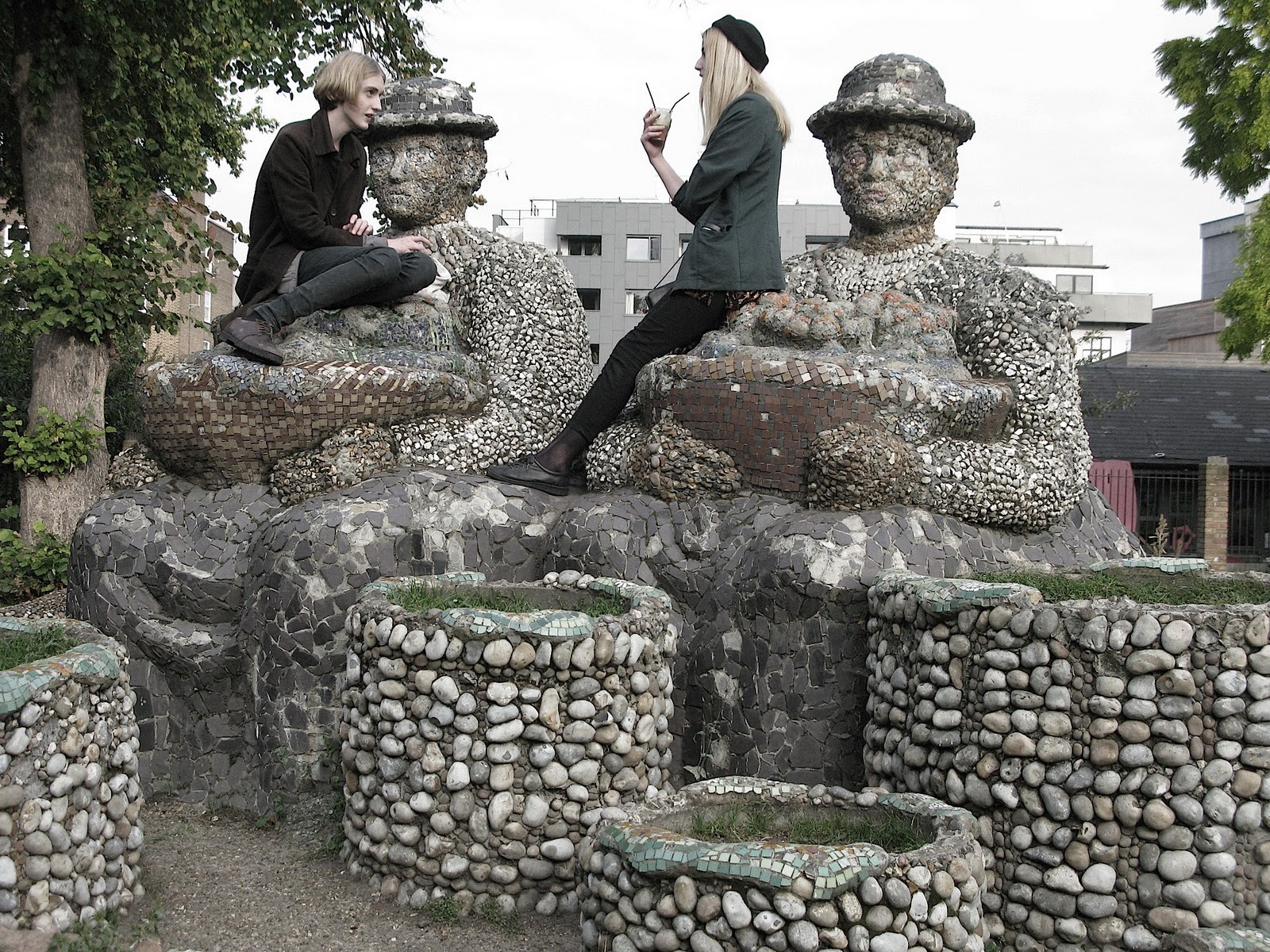
The Flower Sellers are in a children's play area in London Fields, but on a Saturday afternoon, close to fashionable Broadway Market, they are taken over by adults sipping cappuccino and hanging out. The figures represent London costermongers with baskets of produce and a few sheep (not in the picture), commemorating the trade in Victorian times when livestock from Essex was driven through London Fields on the way to Smithfield, then the main meat market, and Broadway was a regular food market. The stones are an allusion to the pearl button decorations worn by the pearly kings and queens, who came out of the costermongering tradition and elaborated the traditional decorations already popular with the street traders. There is something borrowed, too, from those East Anglian cottages studded with pebbles. Designed and constructed in 1988 by Freeform Arts Trust, the community arts organisation based in the nearby Hothouse, the Flower Sellers are made of concrete and decorated with stones and broken tiles, a little bit like the art nouveau sculptures in Barcelona but with an East End palette of greys and browns.

Sunday, 11 September 2011

E17 Art Trail

I'm showing drawings and photographs this weekend as part of the E17 Art Trail. Having an exhibition in your front room (and hall and kitchen) keeps you tied to the house all day. I did get to spend an hour at Barbican Arts, where Michelle Reader's amazing sculptures made out of domestic packaging (pictured) are one of many highlights. Mainly though, tied to the show so I can't get out to see all the other exciting stuff going on in Walthamstow.

There is a selection of my drawings and photographs from the American Midwest on Flickr.

Tuesday, 6 September 2011

Walthamstow... new and old spaces on the E17 Art Trail

Old and new spaces on the E17 Art Trail

The Ruby Stables secret garden is indeed a Walthamstow secret, a rampant garden grown in containers, mixed in with junk, garden furniture and antiques for sale. It isn't new, but showing art there is. As long as the rain holds off, showing oil paintings among the greenery is very effective, the colours sparkling in the sunshine. Slightly naive but accomplished images of summertime parks by Titus Forbes Adam are offset by a psycho portrait by the artist's daughter, Olita-May.

At the Quaker Meeting Room next door, a simple white space flooded with light is bare apart from a single church pew and one chair, and four pairs of headphones. What might be mere tedious pretension is in fact an absorbing experience: relax, appreciate the simplicity and subtle features of the room, and drift off on the suggestions the work evokes. 
At the other end of the High street, it took quite a while to find the Mill because I wrongly assumed it must be the Coppermill on the Walthamstow Reservoirs site, when in fact it's the former library just off Blackhorse Road. Another clean white space, also recently opened. The doors are wide open all day long and the space is immediately welcoming. Paintings and photographs lent by local artists are on display, mainly not for sale - you'd guess many of the artists are not pros and don't want to part with their work. Furniture and fittings are imaginatively built out of scaffolding boards, shuttering ply and recycled plastic, giving the place a pleasing recycled-chic look, so instead of cheap second-hand chairs there are unique solid wood benches. A programme of three minute films was also showing.

Cutting back along Pretoria Avenue, the recent appearance of the Tokarska Gallery in unlikely surroundings at the bottom end of Forest Road (just up from the fish and chips and fried chicken takeaways) comes just in time for the Art Trail. The background to the gallery opening there is apparently complicated, with their website referring to recent art graduate Nadiya Pavliv-Tokarska, and also to an international organisation of the same name. This was the first time I've seen the pristine new white shutters open, which might explain the slightly damp smell inside. Punk Recruit steals the show with his photographs in muted colour of old mannequins crowded into a dingy warehouse. Barely human, he calls them, which is a way of saying how disturbingly human they seem. It will be interesting to see what comes next in this space.

Finally, rather a disappointment at Barbican Arts open show, where a last-minute visit before closing time really seemed like plenty of time to see what there was to see. Some great photographs, but the paintings mainly left us wondering just what the selection/elimination process might have been- but seeing just one work by an artist is seldom the best way to appreciate what they are doing. None the less, the studio opening next weekend is likely to be one of the highlights of the Trail.

Tuesday, 30 August 2011

Ron Arad's Curtain Call at the Roundhouse

A circular enclosure, a curtain suspended from the circular structure of the Roundhouse, forms a 360 degree projection screen. The curtain is made out of silicone rods, like plastic tubing but solid, hung from a circular rail high up in the Victorian ironwork. Like a bead curtain, the rods form a vertical surface but the ends hang free, and you enter by parting the strands and pushing through. The circle is eight metres high and 18 metres across. Twelve projectors, precisely aligned, make for almost seamless all-round projection. Outside the circle, a ring of twelve monitors surrounds the control desk.

So much for the technology. This works as an immersive experience: walk in through the moving image, sit inside surrounded by movement, walk around the outside trailing a hand against the rods, watch the interaction of people and installation. There is a rolling programme of twelve specially created works. The best use the whole space, like Matt Collishaw's Sordid Earth, a tropical thunderstorm mixed in with time-lapse footage of withering orchids. Others simply repeat a projection round the circle, with different degrees of success. Javier Mariscal does that but creates plenty of excitement with his animations and, like Andy Warhol, makes a virtue of repetition.

The Roundhouse advises 'pay what you can' which effectively means pay the recommended five quid, or risk embarrassment on a level with asking for tap water in a restaurant. Some cushions would have been nice - I bet Ron doesn't care to sit on a hard lino floor for two hours.