Showing posts with label Streetlife. Show all posts

Wednesday, 8 October 2014

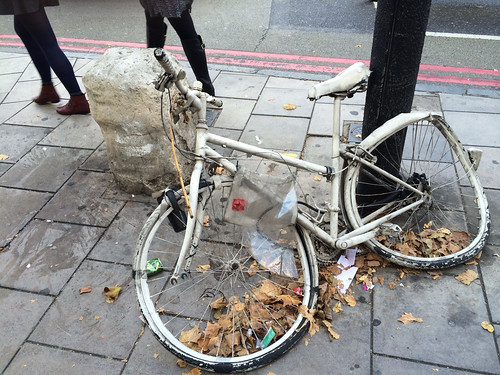
The white bicycle

The mangled remains of a bike, chained to a lamp post on a street corner at Kings Cross. A complete bicycle, more or less - it even has mudguards and a bell. The whole thing painted white, not very carefully, flaking off the rubber to show black beneath. Wheels bent and detached as if some half-wit tried to steal them without realising they were locked to the frame. Not a pretty sight, like a dead thing decomposing on the pavement. You might wonder why the council leave it there in the way of pedestrians, collecting dead leaves and litter. Unfortunately there is a reason for that. In 2011 Min Joo Lee, a 24-year-old fashion student, was killed near there in a collision with a lorry. She was the eleventh cyclist killed in London that year. The bicycle is there as a memorial. But maybe it's been there long enough now?

Wednesday, 21 May 2014

In memoriam

The spot where Mark Duggan was shot in 2011. A few flowers mark the spot, recorded for a while at least on Google Streetview.


Thursday, 20 March 2014

Watching me watching you

A group of workmen installing a camera high up on a pole at a traffic junction in East London, where it is presumably intended to monitor traffic offences, crime and civil unrest. It will of course also pick up images of everyone walking across the junction or hanging out on the street corner. The chap in the foreground isn't posing for a photo, he's approaching to ask why I'm pointing my mobile phone camera at them. Asking politely, as in not making threats and demanding I delete the snaps, but still somewhat aggressively. Which is more than a little ironic, if you think about it.
Actually though, a fixed camera is preferable to the alternative. There used to be a Smart camera car parked at the side of the road, blocking the cycle lane. CCTV cars are allowed to park on yellow lines but blocking a cycle lane during the rush hour is not a great idea, throwing cyclists out into the stream of traffic. That was annoying, but not as annoying as the sense of being watched.
A man in uniform sat in the car, watching. Not always the same man, one would drive off and another would take his place. Every time I walked past I felt watched, even though I knew they were there for traffic control, not random surveillance of the civilian population. They never made eye contact, but if they weren't looking up they could be looking at you on the screen. What a boring job, sitting in a car all day trying to look indifferent, cut off by locked doors and wound-up windows - of course you would watch the people and speculate about some of them. And what an unpopular job. Sometimes we would be treated to an appearance by the protest group that goes around following the spy cars on motorbikes, often wearing the notorious Guy Fawkes masks. They couldn't park but they would ride backwards and forwards across the junction, two to a bike, the pillion rider holding up a placard saying HIDDEN $CAMERA until the car gave up and drove away.
There's something particularly objectionable about the spy cars, the combination of camera and person watching from the safety of a car. Before the cars, sometimes a policeman stood in the same spot, mainly to enforce the no left turn sign, but that was entirely different. Who would object to a person standing in the street, not to make money but to deter antisocial behaviour, out there in the open where you could pass the time of day, ask directions or simply make eye contact, acknowledge each other's existence. Once I got stopped on that corner, turning left with toddlers strapped into their seats on the back seat of my clapped-out Montego, and the police officer was so reasonable about it I thought, he's right, and never did it again, police presence on the corner or not.
So, no more camera cars in this particular spot, and good riddance. The enforcement team is presumably watching a bank of monitors from some remote location, but at least you don't have to see them.

Wednesday, 22 January 2014

Skateboard heaven

The end of the holiday season and rain every day, not all the time but consistently dull overcast weather, drizzle and heavy downpours and just the occasional burst of uplifting sunshine. For once I had a three-week break but gardening in the rain wasn't tempting and long cycling trips were out of the question, so drifting down to the South Bank was inevitable sooner or later. Just before new year's eve, I found myself down there for the third time in as many weeks. It's one of the few places in London where you can be indoors without buying a ticket or eating a meal, sit around in comfortable chairs and use the free wifi, look at things and quite likely drop in casually on some kind of unusual entertainment. There are controversial plans for a huge new extension there, and if nothing else it was an opportunity to look at the way the place is now and what might be lost or gained if the changes go ahead.

Apart from the depressing scrum outside the London Dungeon and only a modest queue for the Eye there wasn't much going on. Nothing on in the Clore ballroom and only a small exhibition of old protest posters upstairs at the Hayward. Outside was bit like a tawdry funfair after the crowds have left: bright yellow staircases bolted on to the wet concrete, a few set-piece attractions scattered around and sad dim fairy lights overhead. A few people were pedalling the two bicycle-powered snow domes but it was hard to see any effect to reward their exertions. The Gift Factory, a plywood shed painted to look like brickwork, was being dismantled - the tall factory chimney lying on the ground while the walls were taken down. Looking down from Hungerford foot bridge, muddy water churned past one of the oval concrete piers. On the flat top of the pier, dozens of unwanted skateboards were scatted around like an abandoned art installation, a sort of impromptu skateboard graveyard.

The skateboarders at least were carrying on as usual, casually executing undemanding jumps and studiously ignoring the audience, such as it was. It's perhaps the most authentic attraction on this stretch of Thames riverfront, apart from the river itself of course. Change is threatening the status quo, though. A small group displayed a placard reading SAVE THE SOUTH BANK and they were selling tee shirts with the same message. Save The South Bank From Relocation, Support Skateboarding, if you read the small text. The Southbank Centre has plans to develop the space and that will mean booting the skateboarders out.

Once upon a time, museums and art galleries didn't sell anything except a few postcards. Going back more than a few years, the QEH had a canteen-style cafe on the ground floor and a huge empty lobby: no bookshop, no restaurants, certainly no shops selling DVDs and designer junk. The Hayward was the same, a cafe on the ground floor where the bookshop is now, not a franchise but run by the gallery. I don't know what has changed to the extent that these places are now desperate to make money but that is certainly the case. Whatever the reasons, the Southbank Centre is hell-bent on expanding and they want more shops to help pay for that to become a reality. Nobody is saying, of course, how much of a difference a few lettable units is going to make. The place they have targeted for more shops is that skaters' paradise, the undercroft of the Queen Elizabeth Hall.

The undercroft is a sunken space with concrete walls, floor, ceiling, concrete ramps and steps, and distinctive mushroom-headed concrete columns, reflecting the brutalist aesthetic of the building above. It was not apparently designed for any useful purpose: it's just a left-over space that has been used for skateboarding and BMX riding since the 1970s. There is a sense of subversion about the place, with wall-to-wall graffiti (albeit neatly masked at the edges), no supervision, a complete absence of any kind of officially-provided facilities. It is very different from a purpose-made skate park, with none of the flowing curves you see in those places. That quality, the not-designed accidental suitability, is exactly what the skaters value. I haven't asked them, but their views are recorded at length on the Long Live Southbank and Save the South Bank websites. This place is the South Bank as far as they are concerned.

The protest is not particularly articulate, focusing as it does on the history of the place rather than its future value, and no doubt it will be over-ruled - even now that Boris Johnson has expressed support. The development proposals put income-generating retail space in this prime spot, inevitably, but a new skate park is also proposed to compensate for the loss of the present space. The skaters' campaign is in fact just the most visible part of wider arguments against the redevelopment proposal. The National Theatre has submitted a detailed statement of objection. The Twentieth Century Society thinks the sixties architecture should be preserved as it is: they commisioned an artist to make illustrations showing the huge glass extension dumped on top of the Albert hall, and another showing it resting on top of the Tower of London, to illustrate their point about cultural vandalism. Others think a huge insensitive addition on top of the Hayward is exactly in the spirit of the developer-driven culture of greed and appropriation that is rapidly changing large chunks of London.

On the face of it, moving the skate park is a reasonable proposition. As the official website puts it, if the Southbank Centre were commercial developers that would probably not happen: the skaters would just be told they have had a good run for free, but not any longer. They do recognise the cultural value and they are trying hard to make the change palatable. Unhelpfully, they are also reserving the right to use the new space for their own events, and perhaps going the wrong way about designing a new space.

The published design is not an unashamedly modern, state-of-the-art purpose-made park. Quite the opposite, it's designed to look accidental, like a bit of post-industrial wasteland that's been tastefully adapted as a skate park. The proposal is ultra-careful to get it right, using French architects who have done this sort of thing before, and even the architects themselves claim to be skaters. Some actual skateboarding persons have even been brought in as consultants. But somehow they have missed the point. Iain Borden, the professor of architecture at University College London, and the man in charge of organising the proposals, admits it would be preferable to keep the existing undercroft. It's an impossible brief, he says. We want a place that is great to skateboard in, but that doesn't look explicitly designed for skateboarding. The protesters refuse to discuss this option at all, and I think they are right. Bogus authenticity: no wonder support is thin on the ground.

 

Saturday, 16 November 2013

A moment's reflection

A rare burst of morning sunshine enlivens the bustle of Ridley Road market in Dalston, open every day except Sunday. Around nine on a weekday the place is a hive of activity with vans unloading and stalls being set out for the day. The sun is low in the sky with one side of the street in deep shadow, while on the sunny side the bright light intensifies the colours of fruit and veg, rolls of fabric and cheap tee shirts, and adds sparkle to pots and pans. The stallholder taking a break with his iPod has evidently got his work done already, waiting perhaps for the first customer to show up.

Tuesday, 22 October 2013

Street photography

Sometimes it all comes together. The guy on his bike, not just any old bike but quite a nice singlespeed with leather saddle and matching leather handlebar tape. Plus a fashionable canvas bag with leather trimmings. But also in the background, that character outside the Japanese Canteen perfectly silhouetted against the rectangle of white, dressed with un-missable bravado and swigging from a can of Coke. You can't plan a shot like this, it's just there and either you get it or you don't. It could have been better focused but at least you can see what's going on. Usually it's gone before you can even think about pointing a camera. Having a camera in your hand helps but the odds are, if you're trying to take photos you walk for an hour and see nothing really worth photographing, take a few shots and delete them later. Other times you just have the camera in case, not really planning to take photos but just out of habit, and something makes you switch it on and point just at the right moment. You could drive yourself crazy always being on the lookout for an interesting shot, better just to carry a camera and see what turns up without looking for it.

Thursday, 17 October 2013

Win an iPad?

"By 'eck our Vera..."
It could be a caption competition. Think up a catchy caption and the best submission wins an iPad. All entries must be in by 25 October. Answers on a postcard, a real postcard with a stamp on it, not a virtual one. However I'm not really offering a prize, just thought I would post this photo of a rather charming pair of visitors to London, trying to get across six lanes of traffic on the Euston Road.

Saturday, 4 May 2013

Through a glass darkly

This strikingly striped taxi is a moving advert for budget fashion accessory chain Aldo, spotted from a bus going up Tottenham Court Road. The taxi overtook the bus, and then both obligingly slowed down just as I got my camera adjusted. The design is one of several by graphic designer Malika Favre, all featuring geometric backgrounds and a face with sunglasses. I dont think it depicts anything specific that Aldo actually sells. Coordinated cycle chic types might think, matching yellow sun specs to go with my yellow bike, but they don't really have them in bright colours.

Photo-based graphics on vehicles is a bit of a trend, printed on flexible plastic film that moulds to the contours of the bodywork. This one works because it's simple and emphasises the pleasing curves of the London taxi. Others are nastier: the Sky vans with lurid photos of TV shows are particularly ugly. There's a lorry I see regularly, printed to look like an oversized wooden crate of potatoes. Sometimes you might wish all vehicles were dignified dull colours with discreet lettering in a nice serif font, preferably gold, like the old Hovis ads. But of course in those days the streets were actually plastered with painted signs on house ends, shopfronts, billboards and sandwich-man boards, buses and commercial vehicles, you name it, huge lettering shouting out trade names and unproven claims. Even more visual clutter than we have today, apparently unregulated and completely lacking in wit or irony. Some of those old signs survive, washed out half-readable remnants left to fade away quietly. The Aldo shrink-wrap, on the other hand, may be here today but it will be gone forever tomorrow.

Thursday, 11 April 2013

Sherlock Holmes's new case

Click to see larger image on Flickr

Wednesday morning in North Gower Street: some unusually large white vans, unmarked, are parked on both sides, and the road is partly closed. Curious passers-by linger for a moment but there's nothing to see. By lunchtime though, there is quite a buzz of excitement, although there's still nothing much happening. The vans evidently belong to a film crew and some equipment is getting set up. There's a boom but no camera so I don't really look any closer. Part of the pavement is marked with bollards and a sign warns, if you enter this zone you implicitly agree to be an unpaid extra, although that's not quite how it's worded.

Word of the filming must have spread because there is a small crowd strung out on the east side of the street, waiting to see what will happen. The pub around the corner provides a clue with the chalked message "tweeds and deerstalkers welcome". Something to do with the Tweed Run, the vintage cycling event? No, I realise - of course it's the return of the TV series that was filmed here last year and the year before. But it's lunchtime and what I actually want is a sandwich, as fast as possible, to take to one of those tedious lunchtime meetings. It's a bit past one so I'm late already, but the Piccolo Sandwich Bar and Cafe down the side street is quieter than usual, and my sandwich is ready fast enough. A generator truck sits outside the cafe, some kind of offload vehicle with huge wheels, completely unnecessary in this setting but rather impressive. There's still no sign of a camera let alone anyone famous so I head off to my meeting, where we will learn how to use the new user-friendly image database.

North Gower Street is home to Speedy's, better known as the cafe next door to Sherlock Holmes's flat in the BBC television series. Baker Street itself is far too grand and touristy to be used as the location and the shabby Georgian terraces of this out-of-the-way street, just around the corner from Euston station, serve the purpose much better. It's also a lot easier to close off to traffic without seriously affecting a whole area of central London. Speedy's is good for bacon sandwiches but otherwise a bit of a dump, one of those cafes that remain in a 1950s timewarp and might do better to clear the place out and start afresh.

There was a bigger crowd after work, and I expect they did get to see some scenes from the forthcoming series starring Benedict Cumberbatch as Holmes and Martin Freeman as Watson. Personally I hate waiting for anything - buses, people arriving at Heathrow, waiting for toast to turn brown, you name it - so I didn't stick around to find out.

Saturday, 26 January 2013

Snow business...

Epping Forest, just a week ago, turned into a version of winter wonderland with every tree delicately piled high with snow, each little twig defined by its own crisp line of snow - and the open grassy meadows turned into an expanse of pure white. The Forest is managed, for strange historical reasons, not as part of Essex but by the City of London, so in a way it's a part of London. There aren't many hills but this little one is convenient for the pub car park next to the Queen Elizabeth hunting lodge, and it seemed to be the popular place to go sledging. In Wales, apparently, there was panic buying with supermarket shelves stripped bare for an emergency that didn't quite happen, but here - apart from a few school snow days - it's just a rare bit of winter excitement.

Friday, 7 December 2012

Free cash

Just a traffic accident, or a ram-raid attack on a City Road cash kiosk?

So what's gong on here? A smashed kiosk is roped off with police tape, sides leaning drunkenly, wires trailing loose and debris scattered around. People stop and take pictures on their iPhones, speculate about what might have happened and move on. The kiosk has signs proclaiming 'Free' and 'Cash Withdrawals' and the company name, 'Cashzone (Every transaction counts)'. A smaller sticker reads 'Ink Stain System Fitted' and, confusingly, 'No Smoking'. The kiosk itself seems to be a converted telephone booth, perhaps not the most suitable use for such a flimsy structure, but the cash machine is still in there, not working, but not noticeably damaged and presumably still full of ten and twenty pound notes. The machine nestles at a angle among the smashed sides, along with an impressively large electric siren and oddly, a bundle of brightly coloured nylon fabric that might be a tent or some kind of safety wear.

Lying behind the rubbish bin, a completely detached sign misleadingly tells you 'Free Cash'. Maybe free cash was the idea behind this, a ram-raid attempt that failed. Cashzone's website reports a recent ram-raid on a convenience store in Warwickshire but doesn't mention this, so maybe it's just the result of bad driving, a lorry reversing inaccurately or a drunken driver losing control. Either way, a graphic reminder that we're not entirely insulated from the possibility of violence.

Monday, 3 December 2012

Warren Street Blues

A grey Thursday morning outside Warren Street Tube station, London, England. Moderately cold with a grey sky and the distinct likelihood of rain. The free magazine guys are busy trying to give away magazines and the bag stall man is busy setting up his stall. Rattling around with his aluminium stepladder, opening up the folding sides of the stall, transforming it like an origami model from a small enclosed kiosk to a much larger covered display, hanging his bags up and plugging in the lights. The ugly mirror glass office block opposite is neatly framed by the curved facades of University College Hospital (more ugly glass, some of it green) and the Underground station (which is dignified brick and Portland stone). There's a row of Boris bikes with wet saddles and few takers. Buses and taxis, lorries and white vans grind past, and a seemingly endless stream of people emerges from the Underground and heads south down Tottenham Court Road, muffled up in hats and scarves, ignoring each other and intent on texting or phone calls, or just focusing directly ahead. All of which might seem thoroughly depressing - at least until a girl in leather hot pants and a red bobble hat glides past inexpertly on her online skates, bumping into people as she goes. I stand still for a moment to take it all in, and strangely enough don't wish I was on a sunny beach in the Mediterranean or stoking up a peat fire in the Outer Hebrides. Think of all those people stuck on a sheep station in the outback or some godforsaken subdivision in the Midwest, let alone all the real hellholes, and just be glad to live somewhere civilised.

Monday, 3 September 2012

E17 in the news

Warehouse fire 25 August
The English Defence League descended upon Walthamstow on Saturday. Despite small numbers, between 200 and 300, the area was completely disrupted from midday onwards. Counter-protesters were kettled at the Bell junction, roads were blocked by an unprecedented army of police and police vans trying to keep the two sides apart, and part of the EDL contingent were still stuck outside Blackhorse Road tube station late into the evening.
 
The event didn't feature at all in the media, apart from the usual alternative internet news and the local paper, the Guardian series, and the Metro website. A warehouse fire (pictured above) the previous weekend made it on to BBC news: nobody hurt and no homes evacuated, although it did take the firemen all day to put it out. But perhaps ignoring the EDF is deliberate. It certainly felt like news if you were in the area at the time.
 

Thursday, 23 August 2012

Headcam crazy

What's this craze for headcams all about?

Filming yourself riding a bike might once have seemed absurdly pretentious, something only an avant garde artist would do, but nowadays the cycle magazines advertise helmet mounted cameras and it's no surprise to discover that people buy them. They even wear them in the street: this guy is at the London Cycling Campaign's Big Ride earlier this year. But while riding a bike is invigorating, frees your thoughts from everyday worries and only gets slightly boring if you do the same route every day, watching a video of someone's bicycle commuting route is of course like watching paint dry. Not exactly riveting.

The original purpose of the headcam was to capture exciting off road action on mountain bikes, so you could re-live the moment and perhaps work out why you crashed. There's a definite trend though, for urban cyclists to wear one on the way to work as a matter of course. I even know someone who does just that.

I suppose there can be exciting moments. Once I cycled the length of Tottenham Court Road holding a digital camera in one hand and steering with the other hand. 'Where's the drama?' my other half sneered, until it came to squeezing through the narrow gap between a bus and a lorry*, dodging pedestrians at the red lights and all that - it looks a lot more dangerous on camera than it really is. Not worth uploading to YouTube though, and soon deleted to free up hard disc space. Back in 2004 someone made a six-minute video of a messenger bike race in New York city that actually did bear watching, but only because it featured a group of riders being outrageously illegal, stopping cars and pedestrians in their tracks.

So do the modern headcammers want to capture bits of everyday excitement? No, apparently it's a form of insurance, a way to record bad driving and aggressive drivers, just in case. There are endless clips posted online featuring petty disagreements between cyclists and drivers. Some not so petty you might think, since they involve death threats, but of course that's all talk except in very rare cases. The trouble with this approach is that it encourages a combative attitude, which weight for weight doesn't look like such a good idea - an average bike weighs around 15kg, maybe 10kg if it's an expensive racing bike, while a typical car weighs 1200kg. It might be a good idea to think twice before you go banging on car windows, shouting at drivers at the next lights - and then threatening them that it's all on video. Getting people angry is not going to make the roads any safer.

*Note: that was a stationary bus and a stationary lorry. You should never ever do that if the vehicles are moving or even have time to move before you get to the next traffic lights.

Tuesday, 5 June 2012

Making Monarchy History

It would be an understatement to say Saturday's Jubilee river pageant was well attended. You might think people have better things to do than stand out in the rain for hours waiting to see some boats go past, but you'd be mistaken. I really ought to know better, but in the event I went along to London Bridge about three o'clock, expecting to catch some of the boats as they passed the finish line, only to find huge crowds milling around up and down outside the station, looking in vain for a way to get to the Thames. We got within range of a big screen on Tower Bridge, but that's no different from watching television at home, if you discount comfort factors like a roof to keep the rain out, a sofa and a loo within easy walking distance. I spoke to a policeman who told me he went on duty at seven in the morning and people were lining the railings even then. A huge number of visitors who didn't have quite that level of determination must have come away without seeing anything at all.

The annoying thing about this is not that there wasn't room for everyone who turned up to get close to the river, but that access was so tightly controlled that the riverside spaces were in fact half empty. Near the London Assembly you could get up to the barriers easily enough, close enough to see spectators a few deep along the riverside railings, and acres of empty wet concrete behind them, but the security staff were not letting anyone through unless they had a ticket (apparently available in advance). This new craze for security may be getting just a little out of hand. Aircraft carriers on the Thames and police with machine guns (no kidding) at London railway stations are just the tip of the iceberg. On this occasion, all the bridges were closed except to invited and security-cleared participants, and there was a control barrier at every single point that gave access to the Thames.

So we had crowds and a cheerful holiday atmosphere, but really nothing happening - except for this small but quite noisy demonstration waving their placards and adding to the congestion on Tooley Street. Better than nothing, and where but an anti-monarchy demonstration would you see the message, 'Down with this sort of thing - careful now'?

Apart from that little gem, we were not amused.

Wednesday, 4 April 2012

London's pigeon menace

A couple of weeks ago I posted this low-resolution photo of pigeons on a tree, taken on my un-smartphone one lunchtime - with the brief caption, "Be a rebel! Feed the pigeons next time you're eating a sandwich out of doors". I didn't actually feed the pigeons at the time, but it did get me thinking. Since then I've noticed what people are saying about the London pigeons in particular, and more generally the theme of nature intruding on our civilised way of life.

Two things particularly stand out.

First of all, there was an article in the Independent extolling the merits of a maze that's temporarily installed in Trafalgar Square. That square is the focus of Ken Livingstone's anti-pigeon campaign: in 2003 he stopped the bird-seed sellers operating in the square, and shortly afterwards banned feeding the birds and introduced fines to back up the ban. Now there are security guards who are quick to move in if they even suspect anyone of breaking the byelaws. The article in the Independent talks glibly about 'flying vermin' and the supposed health hazards, a standard line of anti-pigeon reasoning that is becoming mainstream self-evident wisdom (although the health issue is largely speculation with nothing much in the way of hard evidence to back it up): pigeons are a nuisance on a par with rats and dirty drunks / drug addicts asking for money. A whole industry has grown up to provide pigeon wires, plastic spikes and netting everywhere a pigeon might want to perch, and the language of their advertisements speaks for itself. Pest control. Deterrent. Reducing numbers. Unhygenic. Using hawks to scare off the pigeons is advertised as an environmentally friendly solution.

The second thing that grabbed my attention was an alleged form of malaise that's being called Nature Deficit Disorder. BBC News reported in March that "British children are losing contact with nature at a "dramatic" rate and their health and education are suffering", according to a National Trust report. The NT are latching on to the term Nature Deficit Disorder, which was invented by an American journalist and probably overstates the case for contact with nature at a formative age, but it certainly corresponds to a sense that wholly artificial surroundings can't be entirely healthy at any age.

Pigeons are related to the domestic doves that were widely bred at one time, now reverted to living wild. They look just the same as wild wood-pigeons and make the same rather beautiful cooing call that you hear in the countryside. Most of them look healthy enough - admittedly not all. Watch the way they move as one but compete for the pickings on offer, observe the pecking order in action, and the way they fly off, circle and land again in a loosely coordinated formation. The pigeons were and always had been a popular tourist attraction, as much a feature of central London as the statue of Eros and the flags on the Mall, until Ken decided to get rid of them. Is that really what we want, isn't there another side to the story? Visitors to London used to come to Trafalgar Square specially to feed the pigeons, not to look at half-baked art on the fourth plinth. The problem of course, is that eating outside doesn't mix well with begging vagrants and scavenging birds, so we discourage both as much as possible - but I'd say we lose something in the  process, another part of the natural world swept out of reach. 

So yes, feed the pigeons next time you see them and have a little food to spare. But don't even think about tempting the security guards at Trafalgar Square.

Saturday, 3 March 2012

Pie and mash in E17

L Manze, half way down Walthamstow's kilometre-long High Street, is one of the last surviving pie and mash shops in London, which means one of the last anywhere because they are a London thing, a survival from the cockney past. It's hard to tell if cockney has become just a historic concept: the real east enders are indistinguishable from the population of Essex, and anyway they're outnumbered by artists and yuppie starter home owners. Likewise, in the High Street the old-style cafes face stiff competition from cappuccino and ciabatta, kebab and falafel, colourful cafes in the American style festooned with memorabilia, and the Turkish places open to the street and displaying a huge range of tempting things, stewed meat dishes, grills, salads and fancy cakes. The pie and mash shop stubbornly stays put, with no concessions whatsoever to the modern world.
     No. 76 L Manze Wholesale and Retail, Live Eel Importer, reads the moderately elaborate shop front, alongside a blue Waltham Forest Heritage plaque. Jellied & Hot Eels. Pie & Mash. I visited in February on impulse, partly because I was cold and hungry but mainly to see what it's like inside. The shop is long and narrow, with dark mahogany bench seats, floor to ceiling tiling and a patterned ceiling. Everything brown, white and sludge green with bold black and white chequer tiles up to waist height. There are mirrors set into the tiles, and big brass and copper pots of aspidistras, those most boring of pot plants. The windows were steamed up and I have to confess to feeling something rather oppressive about the place, a bit claustrophobic even though there were only a few other customers. It's a bit of history all right but I couldn't manage the proper sense of reverence. On the contrary, it made me feel that the old days were when people had modest aspirations and knew their place, before cable TV, four wheel drive cars, holidays abroad and all that supposed social mobility.
     The menu is exactly what it's always been. Quite good meat pies with a thin crust and stewed minced beef inside. Mashed potato, which has to be unappetisingly smeared onto the side of your plate with a giant spatula. 'Liquor', which is a sort of bland but bright green gravy, perhaps made from mushy peas. And then there's the eels, which used to be killed to order if you wanted, or you could take them home alive and risk getting bitten. I'm not sure what happens now, but if you eat them in the shop they come cold in briny colourless jelly - disgusting or delicious depending on your preferences - or hot, which is easier to cope with. That's it, the only other food on offer is fruit pie.
     It is apparently quite popular, especially in the nostalgia stakes: Brits living in California or former E17 residents who have escaped to Suffolk and Kent keep a rosy image of the place and the food, and they will visit when they have a chance. Even so, it's impossible to imagine anyone opening a new pie and mash shop now. Anyone who remembers Cookes in Dalston will tell you it was the best of the pie and mash shops, spacious with lots of mirrors, mahogany and marble and all that, but now it's a Chinese restaurant, so you can still appreciate the decor minus the cockney nosh. That's not altogether a bad thing.

Another view, or perhaps the same view differently expressed, is at archipelago-of-truth.blog.co.uk

Sunday, 26 February 2012

The red telephone box

     Poor old telephone boxes. Dirty, covered with stickers on the outside and prostitutes' calling cards on the inside. Who even knows if they still work. Now we've all got mobiles and you wonder who actually uses the public telephones. Men making anonymous calls to those ladies of pleasure, presumably, and perhaps tourists who'd have to pay an arm and a leg to use their own phone on the UK networks. Who else though? Those heritage phone boxes in the photo look the part, but inside is a mess: empty beer cans, unidentifiable stuff festering on the floor, and X-rated postcards, not a healthy environment.
     It wasn't always that way. Long ago, I used to slip out of the house in the morning to call friends before school. We didn't have a phone in our house so you had to walk up to the phone box, further up the village high street, and you'd have to sneak out to avoid having to explain why it was important to talk to someone who would be at the same school an hour later. In those days the telephone was a black metal box with a perspex finger dial, and it took those big pre-decimal pennies in the slot (press button A to talk when the person answered, or press button B to get your money back). Then there was the sneaky way, where you'd lift the handset and tap out the number, ten taps close together for zero and so on, with a longer pause in between numbers. That would get you through for nothing, for no reason that we could ever work out, but sometimes they would notice at the exchange, and a stern lady would come on the line and tell you to stop mucking about. Quite scary, since the exchange was right next door to this particular phone box, and if they thought to look outside they would quite likely know who you were. Don't bother trying it though, it doesn't work on the modern digital telecom system.
     Not so long ago the red telephone box was still the only way to get in touch with people if you weren't at home or work, and people didn't necessarily have a line at home either. The phone boxes were well used. The red paint was kept new and the glass got repaired if a pane was broken. The directory was just left on a shelf, the special directory shelf, and mainly it stayed there - why would anyone nick it when you could get one free from the post office? The phone boxes even had their own special smell, a mixture of damp concrete, cigarette smoke, musty paper and ozone. Just before mobile phones became common, everyone carried a phonecard, but it's difficult to remember what that was about: something to do with vandalism probably. I remember the first time I met someone who had a mobile. It had a hefty handset, like a normal handset but as thick as a brick, attached by a heavy-duty cable to a lead-acid battery, like a car battery but smaller. It was barely portable, but the owner, a building contractor, carried it up to the bare room in a derelict building that was his site office, and impressed the hell out of the rest of us.
     It's not just the hardware though. The mobile phone brought in a whole different attitude to privacy and the way we communicate. At work, people used to make the sort of calls you wouldn't dream of having in public now: to your mother, the bank manager, asking after lost property or making plans for Friday night. Everyone else in the office would listen quite openly and make comments afterwards, sometimes even while you were still on the line. Nobody wore headphones, so that and other verbal exchanges around the office were what kept everyone amused. Even at home calls weren't necessarily private, and funnily enough, most of the time they didn't need to be. They do now though.

Monday, 12 December 2011

Winter Wonderland

A corner of Hyde Park is transformed, for the second year, into the Winter Wonderland Christmas fair. I'd heard about this but not visited before, and expected something along the lines of the modest South Bank stalls, only with a funfair and more trees - a wrong guess, because this is on a completely different scale. There are seriously large structures here, and what must be the biggest, loudest and scariest rides anywhere.

Visiting on a Sunday afternoon at dusk, the trees were still silhouetted against a deep blue sky, but the strings of lights everywhere grab your attention. The whole site is laid out as streets, which does cause a bit of overcrowding, but better that than an empty fairground. Along the main thoroughfare the scale of the temporary wooden buildings increases, from simple shop stands to complex multiple-storey structures. There are several beer halls, including an antique travelling ballroom (apparently) and huge brightly lit fun palaces on the house-of-horrors model, all transported to Hyde Park rather than built from scratch. Good taste doesn't come into it of course, but the attention to detail is impressive - with antique relics, rustic fencing, old cars and even a tree-sized talking tree to add atmosphere (suitably located among a group of real trees on the lakeside). In the middle of all this the ice skating rink is arranged around the bandstand, and it's an unexpected oasis of calm, with static lighting and rather quiet music.

I've seen complaints about the place being crowded and expensive, but don't be put off. Like a lot of things in London, there is no entry fee, no time limit and no obligation to spend money. It's way more impressive than the typical English funfair and just looking is plenty of fun.

Tuesday, 6 December 2011

London's clogged arteries


Every morning the cars, vans and lorries pile into London. On this main road coming in from Essex the traffic is almost entirely one-way, an endless stream of red lights disappearing into the mist, albeit at a snail's pace when there are road works, which there usually are. You have to ask why they do it, when the rate of travel is painfully slow, and the risk of parking fines, arbitrary penalties for things like stopping in those criss-cross junction boxes, and the odd chance to get caught on a speed camera, add up to the absolute certainty of extra expense, stress and annoyance one way or the other. Driving in the city centre is so unpleasant that it's hard to see why anyone would voluntarily opt to travel this way. Door to door convenience and keeping warm and dry come into it, but can it be worthwhile? Of course heavy gear, goods and machinery need to come in a vehicle but most of those cars carry no passengers and nothing heavier than a briefcase. It's not just the shortcomings of public transport. The 26 cars, six commercial vehicles and one airport bus in this photograph probably carry no more than 60 to 80 people, which is less than half the official capacity of a Victoria Line carriage (181 people, 32 of them seated).

There's a story that in rural parts of Europe, people getting on to an empty train will look for someone to sit with: they actually prefer to sit together. Not here though, where everyone's first priority is to grab a bank of four seats and a table all to themselves, spread out their bags and gadgets, and then resent someone else coming along and hoping to sit there. Amazingly, I'm told there are plenty of London commuters who make the journey by road because they prefer to sit in the perceived safety and isolation of their car for however long it takes, rather than be cooped up with a crowd of strangers. No wonder the traffic isn't moving.