Tuesday, 24 April 2012

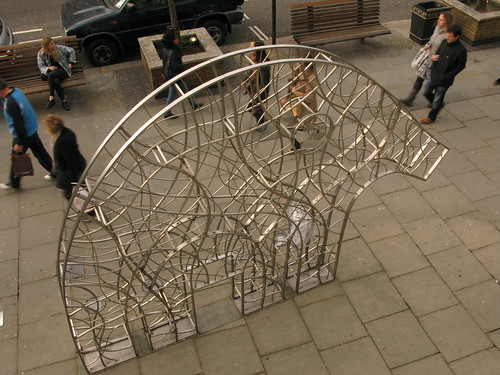
Street sculpture in Notting Hill Gate

Dotted around Notting Hill Gate you might notice little bits and pieces of sculpture, on top of buildings mainly. There's an arcade of shops with stripy mosaic decoration on the pillars, and an abstract mobile that looks like a broken television aerial, clinging to the side of a building. These are all projects carried out by the unlikely-sounding Notting Hill Improvements Group, and it's apparently privately funded and in their own words, 'dedicated to improving the general environment including the character, appearance and facilities provided by Notting Hill Gate for the benefit of both local residents and visitors to the area'.

Star of the show is this quirky stylised elephant, the Carnival Elephant by Lebanese urbanist and sculptor Nadim Karam, made as a sort of trelliswork of delicate stainless steel bars. It's on the pavement outside Waterstones, at the bottom of the steps leading up to a bleak 60's tower block. You might not realise at first what it is, but look closely and there are four legs, eyes and trunk. The eyes are pair of little aluminium propellers, one of which spins but the other one has blades missing, putting it off-balance. The lack of safety measures is refreshing: in 2004 the Group discussed some kind of warning texture in the paving to stop anyone walking into it, but that never got done, so you have to assume people have more sense.

Wednesday, 4 April 2012

London's pigeon menace

A couple of weeks ago I posted this low-resolution photo of pigeons on a tree, taken on my un-smartphone one lunchtime - with the brief caption, "Be a rebel! Feed the pigeons next time you're eating a sandwich out of doors". I didn't actually feed the pigeons at the time, but it did get me thinking. Since then I've noticed what people are saying about the London pigeons in particular, and more generally the theme of nature intruding on our civilised way of life.

Two things particularly stand out.

First of all, there was an article in the Independent extolling the merits of a maze that's temporarily installed in Trafalgar Square. That square is the focus of Ken Livingstone's anti-pigeon campaign: in 2003 he stopped the bird-seed sellers operating in the square, and shortly afterwards banned feeding the birds and introduced fines to back up the ban. Now there are security guards who are quick to move in if they even suspect anyone of breaking the byelaws. The article in the Independent talks glibly about 'flying vermin' and the supposed health hazards, a standard line of anti-pigeon reasoning that is becoming mainstream self-evident wisdom (although the health issue is largely speculation with nothing much in the way of hard evidence to back it up): pigeons are a nuisance on a par with rats and dirty drunks / drug addicts asking for money. A whole industry has grown up to provide pigeon wires, plastic spikes and netting everywhere a pigeon might want to perch, and the language of their advertisements speaks for itself. Pest control. Deterrent. Reducing numbers. Unhygenic. Using hawks to scare off the pigeons is advertised as an environmentally friendly solution.

The second thing that grabbed my attention was an alleged form of malaise that's being called Nature Deficit Disorder. BBC News reported in March that "British children are losing contact with nature at a "dramatic" rate and their health and education are suffering", according to a National Trust report. The NT are latching on to the term Nature Deficit Disorder, which was invented by an American journalist and probably overstates the case for contact with nature at a formative age, but it certainly corresponds to a sense that wholly artificial surroundings can't be entirely healthy at any age.

Pigeons are related to the domestic doves that were widely bred at one time, now reverted to living wild. They look just the same as wild wood-pigeons and make the same rather beautiful cooing call that you hear in the countryside. Most of them look healthy enough - admittedly not all. Watch the way they move as one but compete for the pickings on offer, observe the pecking order in action, and the way they fly off, circle and land again in a loosely coordinated formation. The pigeons were and always had been a popular tourist attraction, as much a feature of central London as the statue of Eros and the flags on the Mall, until Ken decided to get rid of them. Is that really what we want, isn't there another side to the story? Visitors to London used to come to Trafalgar Square specially to feed the pigeons, not to look at half-baked art on the fourth plinth. The problem of course, is that eating outside doesn't mix well with begging vagrants and scavenging birds, so we discourage both as much as possible - but I'd say we lose something in the  process, another part of the natural world swept out of reach. 

So yes, feed the pigeons next time you see them and have a little food to spare. But don't even think about tempting the security guards at Trafalgar Square.

Saturday, 3 March 2012

Pie and mash in E17

L Manze, half way down Walthamstow's kilometre-long High Street, is one of the last surviving pie and mash shops in London, which means one of the last anywhere because they are a London thing, a survival from the cockney past. It's hard to tell if cockney has become just a historic concept: the real east enders are indistinguishable from the population of Essex, and anyway they're outnumbered by artists and yuppie starter home owners. Likewise, in the High Street the old-style cafes face stiff competition from cappuccino and ciabatta, kebab and falafel, colourful cafes in the American style festooned with memorabilia, and the Turkish places open to the street and displaying a huge range of tempting things, stewed meat dishes, grills, salads and fancy cakes. The pie and mash shop stubbornly stays put, with no concessions whatsoever to the modern world.
     No. 76 L Manze Wholesale and Retail, Live Eel Importer, reads the moderately elaborate shop front, alongside a blue Waltham Forest Heritage plaque. Jellied & Hot Eels. Pie & Mash. I visited in February on impulse, partly because I was cold and hungry but mainly to see what it's like inside. The shop is long and narrow, with dark mahogany bench seats, floor to ceiling tiling and a patterned ceiling. Everything brown, white and sludge green with bold black and white chequer tiles up to waist height. There are mirrors set into the tiles, and big brass and copper pots of aspidistras, those most boring of pot plants. The windows were steamed up and I have to confess to feeling something rather oppressive about the place, a bit claustrophobic even though there were only a few other customers. It's a bit of history all right but I couldn't manage the proper sense of reverence. On the contrary, it made me feel that the old days were when people had modest aspirations and knew their place, before cable TV, four wheel drive cars, holidays abroad and all that supposed social mobility.
     The menu is exactly what it's always been. Quite good meat pies with a thin crust and stewed minced beef inside. Mashed potato, which has to be unappetisingly smeared onto the side of your plate with a giant spatula. 'Liquor', which is a sort of bland but bright green gravy, perhaps made from mushy peas. And then there's the eels, which used to be killed to order if you wanted, or you could take them home alive and risk getting bitten. I'm not sure what happens now, but if you eat them in the shop they come cold in briny colourless jelly - disgusting or delicious depending on your preferences - or hot, which is easier to cope with. That's it, the only other food on offer is fruit pie.
     It is apparently quite popular, especially in the nostalgia stakes: Brits living in California or former E17 residents who have escaped to Suffolk and Kent keep a rosy image of the place and the food, and they will visit when they have a chance. Even so, it's impossible to imagine anyone opening a new pie and mash shop now. Anyone who remembers Cookes in Dalston will tell you it was the best of the pie and mash shops, spacious with lots of mirrors, mahogany and marble and all that, but now it's a Chinese restaurant, so you can still appreciate the decor minus the cockney nosh. That's not altogether a bad thing.

Another view, or perhaps the same view differently expressed, is at archipelago-of-truth.blog.co.uk

Sunday, 26 February 2012

The red telephone box

     Poor old telephone boxes. Dirty, covered with stickers on the outside and prostitutes' calling cards on the inside. Who even knows if they still work. Now we've all got mobiles and you wonder who actually uses the public telephones. Men making anonymous calls to those ladies of pleasure, presumably, and perhaps tourists who'd have to pay an arm and a leg to use their own phone on the UK networks. Who else though? Those heritage phone boxes in the photo look the part, but inside is a mess: empty beer cans, unidentifiable stuff festering on the floor, and X-rated postcards, not a healthy environment.
     It wasn't always that way. Long ago, I used to slip out of the house in the morning to call friends before school. We didn't have a phone in our house so you had to walk up to the phone box, further up the village high street, and you'd have to sneak out to avoid having to explain why it was important to talk to someone who would be at the same school an hour later. In those days the telephone was a black metal box with a perspex finger dial, and it took those big pre-decimal pennies in the slot (press button A to talk when the person answered, or press button B to get your money back). Then there was the sneaky way, where you'd lift the handset and tap out the number, ten taps close together for zero and so on, with a longer pause in between numbers. That would get you through for nothing, for no reason that we could ever work out, but sometimes they would notice at the exchange, and a stern lady would come on the line and tell you to stop mucking about. Quite scary, since the exchange was right next door to this particular phone box, and if they thought to look outside they would quite likely know who you were. Don't bother trying it though, it doesn't work on the modern digital telecom system.
     Not so long ago the red telephone box was still the only way to get in touch with people if you weren't at home or work, and people didn't necessarily have a line at home either. The phone boxes were well used. The red paint was kept new and the glass got repaired if a pane was broken. The directory was just left on a shelf, the special directory shelf, and mainly it stayed there - why would anyone nick it when you could get one free from the post office? The phone boxes even had their own special smell, a mixture of damp concrete, cigarette smoke, musty paper and ozone. Just before mobile phones became common, everyone carried a phonecard, but it's difficult to remember what that was about: something to do with vandalism probably. I remember the first time I met someone who had a mobile. It had a hefty handset, like a normal handset but as thick as a brick, attached by a heavy-duty cable to a lead-acid battery, like a car battery but smaller. It was barely portable, but the owner, a building contractor, carried it up to the bare room in a derelict building that was his site office, and impressed the hell out of the rest of us.
     It's not just the hardware though. The mobile phone brought in a whole different attitude to privacy and the way we communicate. At work, people used to make the sort of calls you wouldn't dream of having in public now: to your mother, the bank manager, asking after lost property or making plans for Friday night. Everyone else in the office would listen quite openly and make comments afterwards, sometimes even while you were still on the line. Nobody wore headphones, so that and other verbal exchanges around the office were what kept everyone amused. Even at home calls weren't necessarily private, and funnily enough, most of the time they didn't need to be. They do now though.

Tuesday, 14 February 2012

Lunchtime concert at St Pancras Parish Church

Piano and flute, yet again: a favourite combination for church recitals. One of the nice things about these concerts is being able to sit up front if you want to, seeing what's going on as well as hearing the music. The musicians sitting rigidly still or swaying to keep time, the contrast between delicate, complex fretting movements of the fingers, and the pianist hammering vigourously on the keys in the loud parts, then a hand poised in readiness for what comes next while the other hand plays alone - partly mechanics, partly deliberate dramatisation of the music, perhaps also the performers' unconscious expression of their involvement in playing it. Russian pianist Pavel Timofejevsky and Japanese flautist Kiyoka Ohara played chamber music pieces with the flute dominating, or perhaps I should say providing the leading expressive voice against the piano backdrop. A mixed programme: CPE Bach (son of JS) was forgettable but the rest was better. Schubert's "Arpeggione" sonata, Saint-Saens' Romance for Flute and Piano, and two of Roland Revell's delicate Trois Pensées - which seem to be completely unavailable as a recording, only as sheet music.

On this occasion I got a seat in the front row and took a photograph during one of the breaks for applause. It's the only time I've taken a camera - it's rather bad manners, as well as detracting from intent listening, which is really the only way to appreciate classical music - but just for once I wanted to capture the two performers, the Yamaha grand piano, the amazing spiral stair up to the pulpit and an equally amazing driftwood figure of Christ on the cross, in the background. Here it is.

Friday, 10 February 2012

Occupy LSX - Time to move on?

The Occupy camp at St Paul's is thinning out. After more than 100 days of occupation, there are still as many tents as can physically fit on the site, but the buzz has quietened down. The imaginative posters that used to adorn the stone arcade opposite the cathedral have all been taken down, leaving a few tape marks but nothing worse. Occupy LSX was extraordinarily successful in raising the stakes in the people v the banking system debate, and equally lucky in finding themselves in perhaps the one spot where they would not be summarily turfed out. Now though, the camp is not really in the news any more, and you have to ask - is it time to move on? Wouldn't it be more impressive to announce a moving out date, do a massive clean-up and hand Paternoster Square back to the cathedral, create some positive publicity instead of hanging on until a legal eviction gets under way, almost inevitably with a degree of violence. The protesters will argue that they need to be together in order to have a collective voice, but is that really necessary, when it's possible to meet up for events, and keep in touch via the internet in between times? Well that's what I'd suggest if I was part of the protest camp, but then I'm not.