I went there once, shortly before it closed, had a great evening and won forty quid. Not because I know the first thing about dog racing, just by following what a friend of a friend was betting on. It was quite unique, the combination of the live races and associated betting on the one hand, and on the other the family-friendly night out - junk food and beer, what more could you want? Sophisticated it was not, but adults and children alike were happy. I was sorry to discover my first visit was also to be my last.
Sunday, 15 March 2015
Going to the dogs
I went there once, shortly before it closed, had a great evening and won forty quid. Not because I know the first thing about dog racing, just by following what a friend of a friend was betting on. It was quite unique, the combination of the live races and associated betting on the one hand, and on the other the family-friendly night out - junk food and beer, what more could you want? Sophisticated it was not, but adults and children alike were happy. I was sorry to discover my first visit was also to be my last.
Wednesday, 8 October 2014
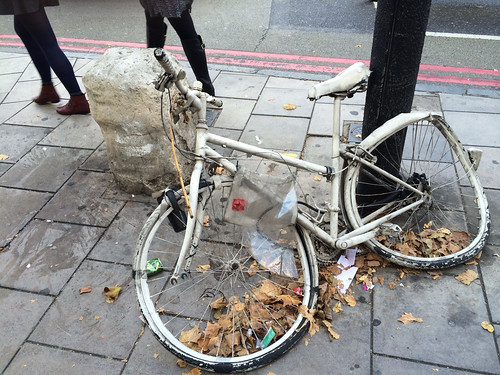
The white bicycle
The mangled remains of a bike, chained to a lamp post on a street corner at Kings Cross. A complete bicycle, more or less - it even has mudguards and a bell. The whole thing painted white, not very carefully, flaking off the rubber to show black beneath. Wheels bent and detached as if some half-wit tried to steal them without realising they were locked to the frame. Not a pretty sight, like a dead thing decomposing on the pavement. You might wonder why the council leave it there in the way of pedestrians, collecting dead leaves and litter. Unfortunately there is a reason for that. In 2011 Min Joo Lee, a 24-year-old fashion student, was killed near there in a collision with a lorry. She was the eleventh cyclist killed in London that year. The bicycle is there as a memorial. But maybe it's been there long enough now?
Thursday, 5 June 2014
Clock this
The Clock House at 13 Pretoria Avenue is just one of the eighteenth-century villas built by wealthy families around Walthamstow village, at a time before all the terraced houses sprang up, replacing the orchards, market gardens and country estates. The area was favoured by merchants, early commuters who could live in style and take a conveniently short coach ride to the City to attend to business. The journey, about seven miles, must have taken no more than an hour.
Waltham Forest council's website has a page devoted to the listed buildings of the borough. It describes the Clock House as "Grade II: Regency style detached villa, erected in 1813 and the original Walthamstow home of the Warner family. Originally set in extensive landscaped grounds fronting Marsh Street (now High Street)". There's a china plate at the Vestry House museum showing a view of the house in its original park setting. Those landscaped grounds surrounding the house were soon developed, though, as Walthamstow became more built-up. The Warner properties along Pretoria Avenue were built in 1888, coming right up to the edge of the house, and Mission Grove was driven through what would have been the front garden. The grand entrance now looks rather out of place so close to the street.
I photographed the house as part of my project to document some of the interesting buildings in the area, and posted the photos on Flickr. Walthamstow man Dan K saw this one and sent me a link to his own photo of the house, with comments sent in over the past few years. A lady by the name of Amanda ("almost 44!") says "I was born and brought up in Walthamstow... We lived in Pretoria Avenue and Chewton Road - in Warner properties (and bought our house in Pretoria from Warners). I expect it's all changed there now - we moved when I was 16 and I haven't been back since my grandparents passed away in the 90s. I miss it - but don't want to go back because I fear it's changed out of all recognition." If nothing else, those new flats behind the house would be a surprise, but otherwise Pretoria Avenue can't have changed very much since then. She continues, "I remember seeing an old photo of it looking very grand in a park like setting - it belonged to the Warner family and I guess it was their home. When I was little it used to be a flour factory and I remember a HUGE chute at the back where sacks of flour used to be shot down to waiting lorries".
The present owner bought Clock House in 1999 when it was used as a warehouse, and spent a year restoring it as flats. He had a hard time convincing the council to allow the change of use, and had to comply with stringent Listed Building requirements for the way the work was carried out. The side of the house had been made into a two-storey advertising sign with lettering made of cement render, which you might think of as an interesting part of the building's history, but that had to be removed. The original stone portico was completely missing, and a new portico was built, no doubt at huge expense, to a historically accurate pattern based on old illustrations and photographs.
Wednesday, 21 May 2014
In memoriam
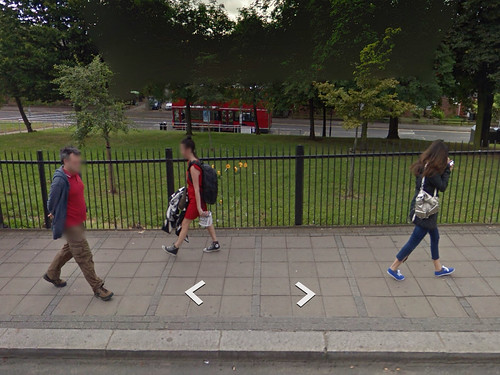
The spot where Mark Duggan was shot in 2011. A few flowers mark the spot, recorded for a while at least on Google Streetview.
Thursday, 20 March 2014
Watching me watching you
Tuesday, 4 March 2014
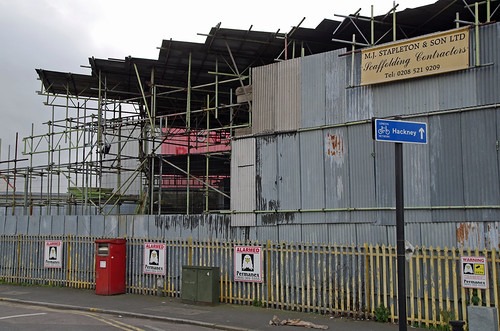
Scaffolding palace
In the industrial depths of Walthamstow, and those do still exist, you can find a baffling array of anonymous sheds, gleaming stainless steel structures of unknown usefulness, just two old factory chimneys (as far as I know) not to mention a thousand white vans. But the premises of M J Stapleton and Son, Scaffolding Contractors, are far from anonymous. Located across the road from the municipal dump (which is now a well-organised recycling centre) their huge enclosure is made entirely out of scaffolding poles and corrugated iron. Which makes perfect sense. The structure is picturesque, although you would not get away with this ramshackle approach in most places. The dump itself has a similar structure, purpose unknown - an open shed ten metres high, containing nothing more than a few old fridges. These pockets of industrial activity are not exactly attractive, but they give a sense of authenticity to the area, a sense that the place exists for a productive purpose beyond just being a place where people live, something that will be missed when the whole lot is pushed out by the ever-expanding demand for land for building blocks of flats.