Saturday, 24 December 2011

Dumb and Dumber

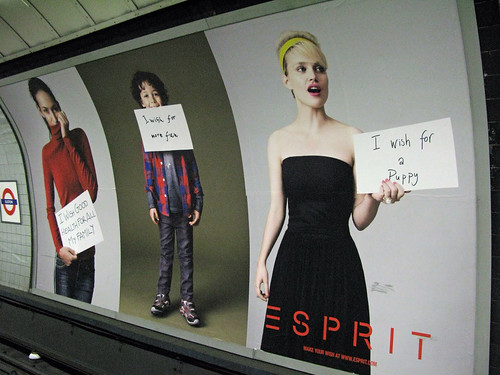
I finally got around to watching the film Dumb and Dumber starring Jim Carrey and Jeff Daniels, a mere seventeen years after it first came out, and laughed so much I cried. Carrey can be extremely annoying, but in this case the humour works - although the characters are stupid, the film is in fact rather intelligently written and tightly directed. Which brings me to today's subject: these posters on the Tube showing bright young things holding up placards inscribed 'I WISH...' So what is that about? There are several versions of the poster with different wishes, and a helpful Internet address links to a lot more. Obviously this is about selling clothes but for once, the advertisements divert attention away from the main object into this eye catching sidetrack. Quite an annoying sidetrack, given the banal wishes and cloying cluelessness they express. I mean, if you can make a wish, it might as well be a decently ambitious one, not just some modest passing fancy. Like those three wishes jokes, you should be careful what you wish for.

The wishes fall into neat categories. Modest wishes (I wish more fun [sic], I wish for a puppy, not to be bored). Ridiculous fantasy wishes (I wish for international travel to be free, to travel the universe in a spaceship). Flaky wishes to change the world (I wish for people to realise their happiness, I wish love to all my loved ones) and the frankly self-centred (I wish to have everything I ever wished for). The standard stuff of the internet age I suppose, all those half-considered contributions vying for attention. The pleased look on the models' faces combined with the nonsense wishes is what I find annoying, but I suppose the target audience will love it, and maybe even send in their own wishes. "I wish for a puppy." Grow up, buy yourself a puppy if you really want one. There are some more personal statements that make a bit more sense (I wish to live in the same city as my sister, I wish to have my book published) . One I rather like runs, 'I wish people on our planet [would] start working together and not against each other'. I don't think that's what the advertising agency was looking for though. It's almost as if stupidity sells.
"Make a wish at www.esprit.com"

Wednesday, 14 December 2011

Fitzrovia's fading mural

Half way down Tottenham Court Road is a gap in the shops, an open space called  Whitfield Gardens. It was once a burial ground, and then made into a public park in 1895. In 1945 a German bomb flattened the Georgian houses that separated it from Tottenham Court Road, making the larger space that exists now. All very typical of London: what's left is an accident of circumstances, an odd space  with the single surviving building sitting isolated in the middle of an expanse of concrete paving.
And dominating that space is the 1980 Fitzrovia Mural, faded and peeling, and covered in graffiti as high up as the spray-can artists can reach. People are quite attached to this mural. There was a fashion for murals at that point in history, and this one was commissioned by Camden Council, who own the building it is painted on. The Fitzrovia Neighbourhood Association are campaigning to get it restored, although realistically they admit the wall would have to be repaired first, so the whole thing would actually need to be re-painted from scratch. Some of the subjects are local characters of the time, perhaps not all of them forgotten. There are some nice touches with contemporary relevance: the cigarette advertisement featuring a death's head, the machines spewing out bills and final demands, and of course the developer's crane towering over everything else. Even so, it doesn't have the historic value of the Cable Street Anti-Fascist mural or the Hackney Peace Carnival mural, both in much better condition.

Like the 1960 BT Tower behind it, it's past its best and not that relevant any more. The tower recently lost all the satellite dishes which is what it was for in the first place, removed for 'safety reasons' which will inevitably make space for more advertising, but as an iconic landmark there's a lot of life left in it yet (the photo at the top of this blog shows how it used to be). That painted end wall is just paint, and maybe it's time to treat it as the ephemeral statement it was intended to be. Maybe it's time to make a fresh start with some imaginative, good quality landscaping and some artwork relevant to the twenty-first century.

Monday, 12 December 2011

Winter Wonderland

A corner of Hyde Park is transformed, for the second year, into the Winter Wonderland Christmas fair. I'd heard about this but not visited before, and expected something along the lines of the modest South Bank stalls, only with a funfair and more trees - a wrong guess, because this is on a completely different scale. There are seriously large structures here, and what must be the biggest, loudest and scariest rides anywhere.

Visiting on a Sunday afternoon at dusk, the trees were still silhouetted against a deep blue sky, but the strings of lights everywhere grab your attention. The whole site is laid out as streets, which does cause a bit of overcrowding, but better that than an empty fairground. Along the main thoroughfare the scale of the temporary wooden buildings increases, from simple shop stands to complex multiple-storey structures. There are several beer halls, including an antique travelling ballroom (apparently) and huge brightly lit fun palaces on the house-of-horrors model, all transported to Hyde Park rather than built from scratch. Good taste doesn't come into it of course, but the attention to detail is impressive - with antique relics, rustic fencing, old cars and even a tree-sized talking tree to add atmosphere (suitably located among a group of real trees on the lakeside). In the middle of all this the ice skating rink is arranged around the bandstand, and it's an unexpected oasis of calm, with static lighting and rather quiet music.

I've seen complaints about the place being crowded and expensive, but don't be put off. Like a lot of things in London, there is no entry fee, no time limit and no obligation to spend money. It's way more impressive than the typical English funfair and just looking is plenty of fun.

Tuesday, 6 December 2011

London's clogged arteries


Every morning the cars, vans and lorries pile into London. On this main road coming in from Essex the traffic is almost entirely one-way, an endless stream of red lights disappearing into the mist, albeit at a snail's pace when there are road works, which there usually are. You have to ask why they do it, when the rate of travel is painfully slow, and the risk of parking fines, arbitrary penalties for things like stopping in those criss-cross junction boxes, and the odd chance to get caught on a speed camera, add up to the absolute certainty of extra expense, stress and annoyance one way or the other. Driving in the city centre is so unpleasant that it's hard to see why anyone would voluntarily opt to travel this way. Door to door convenience and keeping warm and dry come into it, but can it be worthwhile? Of course heavy gear, goods and machinery need to come in a vehicle but most of those cars carry no passengers and nothing heavier than a briefcase. It's not just the shortcomings of public transport. The 26 cars, six commercial vehicles and one airport bus in this photograph probably carry no more than 60 to 80 people, which is less than half the official capacity of a Victoria Line carriage (181 people, 32 of them seated).

There's a story that in rural parts of Europe, people getting on to an empty train will look for someone to sit with: they actually prefer to sit together. Not here though, where everyone's first priority is to grab a bank of four seats and a table all to themselves, spread out their bags and gadgets, and then resent someone else coming along and hoping to sit there. Amazingly, I'm told there are plenty of London commuters who make the journey by road because they prefer to sit in the perceived safety and isolation of their car for however long it takes, rather than be cooped up with a crowd of strangers. No wonder the traffic isn't moving.


Thursday, 24 November 2011

Russian constructivism at the Royal Academy

The courtyard of the Royal Academy is currently the setting for this steel tower, a striking twin spiral supported on zigzag bracing, but somewhat overwhelmed by the architecture surrounding it. It is in fact just a scale model of the tower designed in 1920 by Russian architect and engineer Vladimir Tatlin, just three years after the October Revolution and before the USSR was established. Designed as a monument to the Third International, only a model was built at the time, and now just Tatlin's drawings survive. If it had been built, it would be 400 metres high, higher than the Eiffel Tower in Paris.

It's widely held to be a masterpiece of Constructivism, the avant garde movement linked with the early years of the communist state - before reaction and repression set in. Conceived at a time that coincides with the Edwardian period in England, it's quite difficult to understand such an abrupt change, from the amazingly modern and forward-looking futuristic designs adopted by the budding socialist state, to the suppression of artistic expression that followed on all too soon.

Tatlin's masterpiece would have towered high above St Petersburg, but it was never built because of political uncertainty, perhaps because it was physically impossible, and because it would have been extraordinarily expensive. None the less it remains legendary both as an early expression of modernism, and as some kind of socialist icon.

The scale model at the RA was designed by architect Jeremy Dixon, who made a slightly smaller wooden version for an exhibition at the Hayward in 1971. This time around he has the benefit of computer aided modelling, not available in the 1970s, but because it's based upon drawings and photographs of the original model, none of which are the same, it's an interpretation rather than an exact scale copy. That circular base has nothing to do with Tatlin's design and rather spoils the effect of the dynamic form rising out of the ground, dissipating the vertical thrusting energy by introducing that broad wedding-cake base. No doubt that keeps it nice and stable, but it would have been better without it, better still if the whole thing was twice as big and really dominated the RA courtyard.

Saturday, 19 November 2011

Walk don't run

Not a murder scene, this slightly alarming black figure is stuck to the floor of Victoria Station to reinforce the message, "You'll run into trouble if you run in stations". The way railway stations are organised, with platforms announced at the last minute, running for the train en masse is the norm. You might think a human figure would at least attract attention but people were casually stepping on this sign as if it wasn't there. It won't work, but it's quite graphically stylish, in the tradition of the signs you used to see on the Tube. I wonder if anyone remembers the London Undergound  "Keep Feet off Seats!" sign when it showed two feet, one in clumpy lace-up boots and and one in high heels, in the days before signs all went down the pictogram route? It's refreshing to see a sign with a depiction of the human figure that isn't quite reduced to the stick-man level. Actually he has a lot in common with the London Sidelines silhouette man (on the sidebar, scroll down a bit). Perhaps they will introduce a female version too.