Thursday, 19 July 2012

Get your bike fixed?

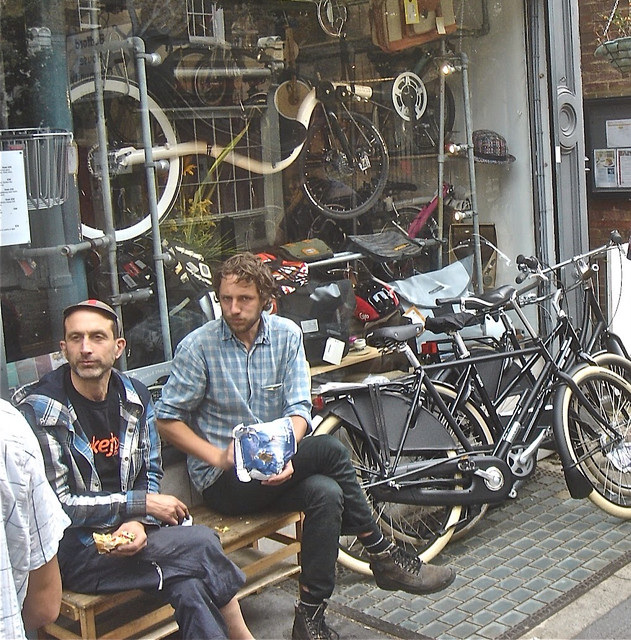
The other day I visited my favourite bike shop, Bikefix in Lambs Conduit Street. The owner mentioned that they get some bad reviews online, so I checked it out next time I got to a free wifi cafe. What a lot of negative comments! Of course all bike shops get that sort of review, it's not that Bikefix has a monopoly on negativity, but it does seem a bit above average. Actually it's quite a special place, full of odd bikes and nice accessories that you would never see anywhere else, and a complete antidote to the On Your Bike type of bicycle supermarket. You might even meet some interesting people there, especially if talking bikes is your sort to thing.

So why the comments? The issue here seems to be a huge comprehension gap. It's a bit like when I try to explain to my wife what's going wrong with our loft conversion: I'm an architect but she knows absolutely nothing about the practicalities of building, so I end up sounding like a condescending arsehole (so I'm told). We just don't speak the same language, although being an architect I can at least draw pictures to make things clearer, but it's also a matter of different priorities, different values. Bike shops are like that. You come in with your typical ordinary bike and you know there is something wrong with it. Maybe the chain keeps coming off, or it won't change gears any more. Probably you've already decided how much it's worth to get it fixed and you hope to get it back in time to ride home that evening, if not within the next fifteen minutes. Now, the staff at Bikefix are without exception bike nuts, like most proper bike shop staff. They know about every kind of bike there is and probably have some heavily customised machine of their own that they change around every week to make it cooler, or faster, or just plain different. What are they going to think of your ordinary bike? Well, to keep it short, they are going to see more wrong with it than you do. They know what they would do if it was their bike (strip it right down and replace most of the parts, throw out those luggage racks and all those unnecessary bolted-on bits, maybe even a quick spraycan job to brighten up that dismal dull silver-grey finish). What can they do about your problem? They know exactly what will happen if they just replace the bit you think needs replacing: the chain will still come off, or the gears will be ok for a week and then start to seize up again. So they explain what they see as the way to sort it out permanently, and of course it's five times the figure you had in mind, maybe more than you paid for the bike in the first place. And it will be ready on Thursday, not today. After all, it takes time as well as parts, and shops only exist to make a living wage. Of course that's not what inevitably happens - most repair jobs are actually quite straightforward - but you can see the scope for frustration. That's one route to disillusionment, but maybe also inspiration to put your money in the right place and invest in a decent bike, whether by ditching your old piece of crap or by getting it to work nicely.

At the other end of the scale, some of the gadget freaks who like expensive bikes are among the most persnickety people in the world. Is that a proper English word? It certainly feels like the right word to describe that particular combination of uncertainty and obsessive attention to detail. Take a look at a specialised bicycle forum if you don't believe me, or have a laugh at the one review of Bikefix on Time Out. These people know enough to know what they don't like but not enough to know how to achieve what they do want. A no-win situation for everyone involved, potentially.

Do satisfied customers wrote reviews? I once bought a lemon-yellow Brompton there. They have an excellent online system for choosing all the different options for colours, gears, type of handlebar etc. but after I did that I went in to finalise the order. They didn't like the colour but they didn't try to change my mind, and warned me accurately about what was then a long order time. It certainly didn't occur to me to find an online review site and say how the yellow was exactly as lemony as I hoped and the bike had absolutely nothing wrong with it. Between the two extremes, Bikefix is a pleasure to visit and they can usually do or get whatever it is that you want. Within reason.

Monday, 2 July 2012

Post industrial landscape in East London 3/3

We rejoin the Greenway where it crosses the A12. There is now a brand-new bridge (not yet open) and a pedestrian crossing in case you don't care to climb all those steps. Like the way the Greenway itself has been improved for the Olympics, it's stylish and imaginative. It's interesting to see the way the Olympic landscaping incorporates bits of old concrete and metal, unusual seats designed by students and bits of arty sculpture to make something interesting out of what was really a bit grim. There are security guards here too, but only patrolling the perimeter of the Olympics site and presumably only for the duration of the event.

We stop to admire the ornate Victorian buildings at Abbey Mills pumping station. After that the improvements fizzle out and the route is somewhat older, cracked tarmac and concrete, endless terraced houses both sides, and little roads that cross over the Greenway at intervals. These junctions all have metal gates, randomly wide open or locked shut, and those annoying bicycle barriers where you have to get off and push your bike underneath the bar. You can just about straddle the crossbar to squeeze under without dismounting. Seeing my strained expression a passer-by advises me to "watch yer head". It's not my head I'm worried about though. "Oh yeah, see where you're coming from there mate" he sniggers. Time to move on.

We ride the remaining four miles to Beckton uneventfully. Completely losing the route at the A13, we climb the giant spoil heap known as Beckton Alps to see where we are. The bottom of the 'Alps' is a nice winding path through the trees, but higher up, inexplicably, we find the top, the open bit with the view, is completely surrounded by a high metal security fence. Fortunately some public-spirited person has removed a few railings so we can squeeze through, minus bikes, and climb to the top. What a view! This must be the only place where you can see the whole of the city spread out before you: Greenwich, Canary Wharf, the Gherkin and the Shard, Stratford and the Orbit tower at the Olympic site, all spread out in one amazing vista. It's the one photograph I take all day, knowing a photo can't hope to convey the scale of all this.

Thursday, 28 June 2012

Post-industrial landscape in East London 2/3

Not so long ago the marshes were a wasteland, more or less unregulated, with burnt-out cars and occasionally kids riding motorcycles, but also a true sense of wild untended nature. You could walk or ride a bike where you wanted, climb trees and bring a rope to make a swing, very like the wastelands I loved when I was a boy. The role of the LVA is to turn that into a properly regulated nature park, because for various reasons wasteland is no longer acceptable, especially perhaps because a wasteland could be taken over for development while a park cannot. Whatever the reasons, the Lea Valley is of course a huge asset to the area, but with regulation and management come corresponding opportunities for people using the place to be fenced off, confronted with prohibition notices, or actually told off in person. At one point the Authority got rid of their park rangers, who were of course educated and polite people who walked around the nature reserves, and replaced them with private security patrols who dressed in black, drove unmarked white vans, and of course knew nothing whatsoever about wildlife or walking routes. These characters made a point of interfering with families eating picnics and children climbing trees, let alone youths with a ghetto blaster and cans of beer, on the basis that they're keeping the place safe, but missing the point that perhaps the level of contact with the public might be a little excessive, and their image more threatening than reassuring. Perhaps people more vocal than myself have persuaded the Authority to tread more lightly, because I haven't seen them lately.

That was the LVA's worst excess, putting into perspective minor annoyances like unnecessary gates and barriers (supposedly only temporary), and their failure to get rid of the rubbish or to make decent paths. The chain of reservoirs nearby looks like going the same way. Currently they are operated by Thames Water, who maintain the place efficiently but leave the margins entirely wild, a true nature reserve in the sense that wildlife coexists naturally with the function of the place. Only fishermen go there, putting a pound in an envelope and dropping it into the honesty box. Now Waltham Forest have won lottery money to turn the place into another nature park. Catch it while you still can and see the difference for yourself.

Across Hackney Marsh football fields, a vast expanse of grass that's escaped the grasp of the Olympics, we get on to the canal towpath. The towpath recently got the Olympic upgrade treatment, properly laid paths that are maybe less fun than awful muddy ruts but actually quite nice for cycling, now the loose gravel is starting to bed down to a less slippery surface. Alongside the Olympic site the graffiti-covered warehouses and artists studios are still there, surprisingly not wiped out by new developments, although you can see the signs of change everywhere. One old warehouse has huge new windows cut through the graffiti-covered brickwork, and a concrete-framed building next to the lock suddenly has new glass walls, with the steel skeleton of the old loading bay still suspended over the canal.

Tuesday, 26 June 2012

Post-industrial landscape in East London 1/3

According to Wikipedia, "the Northern Outfall Sewer is a major gravity sewer which runs from Wick Lane in Hackney to Beckton Sewage Works in East London; most of it was designed by Joseph Bazalgette after an outbreak of cholera in 1853 and 'The Big Stink' of 1858." Fortunately that is not apparent when you're standing on top of it, because it's part of our route for the day's cycling trip, eight and a half miles from Walthamstow to Beckton on the Thames estuary. Starting from Blackhorse Road, the way is flat and mainly traffic-free, passing through various places that were once post-industrial wasteland, now in their various ways reclaimed as leisure facilities. We already know the landscape as far as the Olympic site, but the idea today is to explore right up to the end of the line, the Thames at the far end of Royal Victoria Dock.

Things get off to a bad start with a flat tyre on one of the bikes, but that is soon mended and we start out on the familiar route down to the canal. Just ten minutes on the roads before we get down to the fortress-like waterworks on Coppermill Lane. Half a mile of un-climbable wire fence with a vehicle crash barrier behind it: with a couple of watchtowers and armed guards patrolling the perimeter it could easily pass for a Cold War concentration camp. Who knows what paranoic scenario prompted those defensive measures.

Across Leyton Marshes, a wide path lets you cycle side by side, although we're not very good at keeping pace. I keep getting ahead and stopping to wait for my companion to catch up, except for the times when I stop to take photographs while she disappears into the distance, unaware that I've stopped. The path takes you along a high embankment, with the horse riding school on one side and the marshes on the other, then twin tunnels under Lea Bridge Road. The tunnels flood sometimes, usually just a few inches of water, but occasionally a proper flood two metres deep. You can cycle through the smaller floods but it's easy to misjudge the depth, inevitably soaking one or both feet because you can't stop pedalling.

A twisting path from there leads to the bridge over the River Lea, once bright red but now faded to dusty pink. Giant hogweed grows on the river banks, maybe three metres tall and highly poisonous. You can get a nasty rash just by touching it, and no doubt one day it will be exterminated by the Lea Valley Regional Park Authority, but while it lasts it's rather spectacular, perhaps the biggest plant that grows wild in this country.

Part 2 tomorrow

Thursday, 21 June 2012

London Festival of Photography, a critical tour

 
A strong showing this year from the still-growing London Festival of Photography, and just a week left to take in all the exhibitions and events. I cycled around some of the shows on the first weekend and still haven't caught up with the rest of the things on my must-see list. Clearly the street photography shows are among the most interesting, but there are some unexpected gems in the smaller shows.

There are 24-hour displays at both Kings Cross and St Pancras, Contemporary Street Photography at Kings Cross and The Great British Public, from the book of the same name, at St Pancras. Half the fascination, though, is not so much the actual photographs, as getting carte blanche to walk through normally closed doors. In a borrowed or temporary gallery on the top floor of a seedy Oxford Street building is the International Street Photography awards show, where windows uncleared for decades look out over the taxis and buses. The photos are original and striking, although I was sorry to see the winning view of Mexican workers sleeping in the back of a moving pickup truck, had been repeated with endless variants.

Repetition is all too common in photography - making series of images instead of thinking up new approaches - but unique images are much more interesting. One of the shows at the Fitzrovia Community Centre, Behind Closed Doors, is another case in point. The stories of abuse suffered by female domestic staff in France are well worth reading, but all those images of anonymous apartment buildings, the scenes of those crimes, really add very little to the project. So much easier than photographing the abused women, or stalking the perpetrators to publicly shame them, but the buildings tell you nothing except that there must be thousands more cases of exactly the same kind of bad treatment. The Single Saudi Women show by Wasma Mansour similarly disappoints: the women barely appear and their surroundings are merely ordinary.

The Horse Hospital, normally un-noticeable around the back of Russell Square tube station, is suitably weird, a ramp instead of stairs and a miniature stage draped in red velvet. The family history recorded there by Kurt Tong is reasonably engaging, but only if you can be bothered to read all the background information.

Two shows near Euston are much better versions of the personal narrative. At the William Road Gallery, which is actually the reception area for architects John McAslan and Partners, are several intense and fascinating collections, especially Celine Marchbank's record of her mother's terminal illness, put together with considerable wit and barely a hint of pathos. Also striking are Evgenia Arbugaeva's images from Siberia, showing at Calumet: revisiting the small and desolate town in Siberia where she grew up, she finds a young girl to pose, in a sense, as her younger self. The poverty of the post-USSR town is striking, bleak concrete apartment buildings and battered interiors, contrasting against the moonscape beauty of the landscape. The girl poses in her bedroom, on the prow of an icebound ship and balancing on rusty machinery, throws her shadow against an abandoned building, runs with a meteorological balloon nearly as big as she is, stands balanced on a tiny raft on the icy waters of a lake. Again, imaginative and unsentimental. I've taken the liberty of copying one of her images above. There is more to enjoy on her website http://www.evgeniaarbugaeva.com/, or get down to Calumet while it's still on.

Tuesday, 5 June 2012

Making Monarchy History

It would be an understatement to say Saturday's Jubilee river pageant was well attended. You might think people have better things to do than stand out in the rain for hours waiting to see some boats go past, but you'd be mistaken. I really ought to know better, but in the event I went along to London Bridge about three o'clock, expecting to catch some of the boats as they passed the finish line, only to find huge crowds milling around up and down outside the station, looking in vain for a way to get to the Thames. We got within range of a big screen on Tower Bridge, but that's no different from watching television at home, if you discount comfort factors like a roof to keep the rain out, a sofa and a loo within easy walking distance. I spoke to a policeman who told me he went on duty at seven in the morning and people were lining the railings even then. A huge number of visitors who didn't have quite that level of determination must have come away without seeing anything at all.

The annoying thing about this is not that there wasn't room for everyone who turned up to get close to the river, but that access was so tightly controlled that the riverside spaces were in fact half empty. Near the London Assembly you could get up to the barriers easily enough, close enough to see spectators a few deep along the riverside railings, and acres of empty wet concrete behind them, but the security staff were not letting anyone through unless they had a ticket (apparently available in advance). This new craze for security may be getting just a little out of hand. Aircraft carriers on the Thames and police with machine guns (no kidding) at London railway stations are just the tip of the iceberg. On this occasion, all the bridges were closed except to invited and security-cleared participants, and there was a control barrier at every single point that gave access to the Thames.

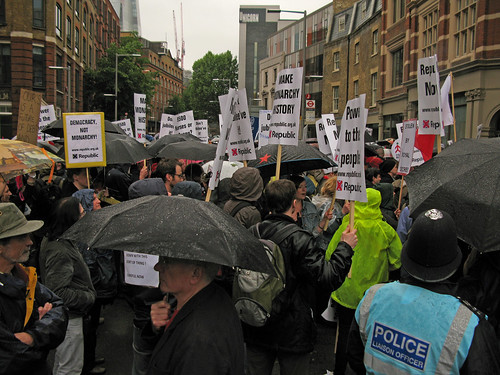
So we had crowds and a cheerful holiday atmosphere, but really nothing happening - except for this small but quite noisy demonstration waving their placards and adding to the congestion on Tooley Street. Better than nothing, and where but an anti-monarchy demonstration would you see the message, 'Down with this sort of thing - careful now'?

Apart from that little gem, we were not amused.