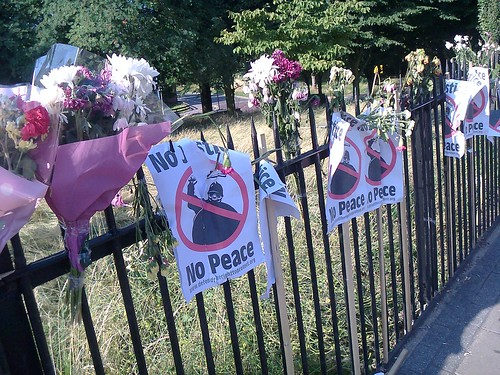
'No Justice, No Peace' read the placards at the spot where Mark Duggan was shot. For the first few weeks after the event there were masses of flowers and cards attached to the railings, and then that was all cleared away and nothing was left but bare railings. Recently, around the second anniversary, and with the subject still in the news, this little display sprang up. That phase comes from the LA riots in 1992, and it's found various uses since. Already, the flowers and placards are gone, leaving just the sticks sellotaped to the railings. Maybe it's best that the spot remains unmarked, although the shooting and subsequent riots will stick in the collective memory for a long time.
Monday, 19 August 2013
Monday, 12 August 2013
Summer
Summer is for being out of doors, not sitting in front of a screen. Even if it looks like it might rain.
Tuesday, 11 June 2013
Lost in the labyrinth
This is one of many vitreous enamel plaques that have recently appeared in tube stations, looking oddly official, perhaps because enamelled steel is used for most of the Tube maps and signs. They are in fact works of art, perhaps something to make up for the advertising excesses on the Underground. There will be 270 plaques when the project is completed, with a different design on each. They are all similar - a black labyrinth on a white background with a small red detail and a number - but each is unique. The designs, and presumably the original idea, are by artist Mark Wallinger, perhaps best known for his contribution to the Fourth Plinth, a naked figure with a crown of barbed wire (apparently - I completely missed it and just found that on Wikipedia). Nice to see cash-strapped London Underground can still spend money on art, and can still do it this well.
Saturday, 4 May 2013
Through a glass darkly
This strikingly striped taxi is a moving advert for budget fashion accessory chain Aldo, spotted from a bus going up Tottenham Court Road. The taxi overtook the bus, and then both obligingly slowed down just as I got my camera adjusted. The design is one of several by graphic designer Malika Favre, all featuring geometric backgrounds and a face with sunglasses. I dont think it depicts anything specific that Aldo actually sells. Coordinated cycle chic types might think, matching yellow sun specs to go with my yellow bike, but they don't really have them in bright colours.
Photo-based graphics on vehicles is a bit of a trend, printed on flexible plastic film that moulds to the contours of the bodywork. This one works because it's simple and emphasises the pleasing curves of the London taxi. Others are nastier: the Sky vans with lurid photos of TV shows are particularly ugly. There's a lorry I see regularly, printed to look like an oversized wooden crate of potatoes. Sometimes you might wish all vehicles were dignified dull colours with discreet lettering in a nice serif font, preferably gold, like the old Hovis ads. But of course in those days the streets were actually plastered with painted signs on house ends, shopfronts, billboards and sandwich-man boards, buses and commercial vehicles, you name it, huge lettering shouting out trade names and unproven claims. Even more visual clutter than we have today, apparently unregulated and completely lacking in wit or irony. Some of those old signs survive, washed out half-readable remnants left to fade away quietly. The Aldo shrink-wrap, on the other hand, may be here today but it will be gone forever tomorrow.
Sunday, 21 April 2013
Another Thursday, another lunchtime recital
18th April: Zoe Lethbridge - flute and Julian Collings - organ, perform a programme of original works for flute and organ including works by Frank Ferko and JS Bach.
Looking at the options as one o'clock approaches, there's a choice between a single concerto by Brahms at Munster Square, or a selection of pieces for organ and flute at St Pancras Parish Church. The organ is obviously a more enticing prospect. St Pancras recitals start when the church clock strikes a quarter past one, so there's time to get there without bunking off work early, and collect the handout with a couple of minutes to spare. It's up there, the white-haired gent on duty tells everyone as they come in, pointing at an apparently empty corner of the balcony. You'll have to twist round in your seat to see.
That makes for a very odd concert and might explain why people are walking out as well as in. Usually the place is reasonably full, not full as in every seat taken, but maybe fifty people or so. Today the number stabilises at just nineteen people, including me and the man in charge, scattered around the place. Some of them actually are twisted round to see something, but mainly they are just sitting and listening. That's one approach to music: sit well back, maybe close your eyes, and absorb the music. The architecture of the church is interesting, so at least there is something to look at. What I like though, is to watch the performers and get a visual sense that the music doesn't just exist in a vacuum: to actually see the concentration and skill that go into making it happen. The way things are set up this time, that experience is tantalisingly close but never quite realised.
Up in the gallery, where the public isn't allowed to sit, is the organ and the keyboard console, which is a big wooden box set away from the organ pipes, with the organist completely hidden behind it. Our flute player is almost visible, a willowy figure with crazy long hair, but she's hiding behind the music stand and most of the time all you can see is knees and the end of the flute. After a while I get up and walk along the side aisle to see if there is a better viewpoint. There isn't. Once the organ gets going, though, the music makes up for all that.
Sunday, 14 April 2013
Lunchtime recital at St Mary Magdalene Munster Square
For me, it's a touch of the unexpected magic that sometimes happens when you go to a recital knowing nothing about the performers or the music, and find yourself not wanting the moment to end. The songs have lurid titles: "I cannot grasp or believe it", "He, the noblest of all", "Now you have caused me pain for the first time". She explains the story of some of the them: Strauss's 'Die Nacht', she tells us, is about a woman and "her fears that the creeping shadows of the night, that steal away all colour and life from her room, will also steal away her lover..." Romantic histrionics, then, best appreciated in a language you don't understand. My sandwich remains half-wrapped, uneaten until it's time to go outside into the rain.